
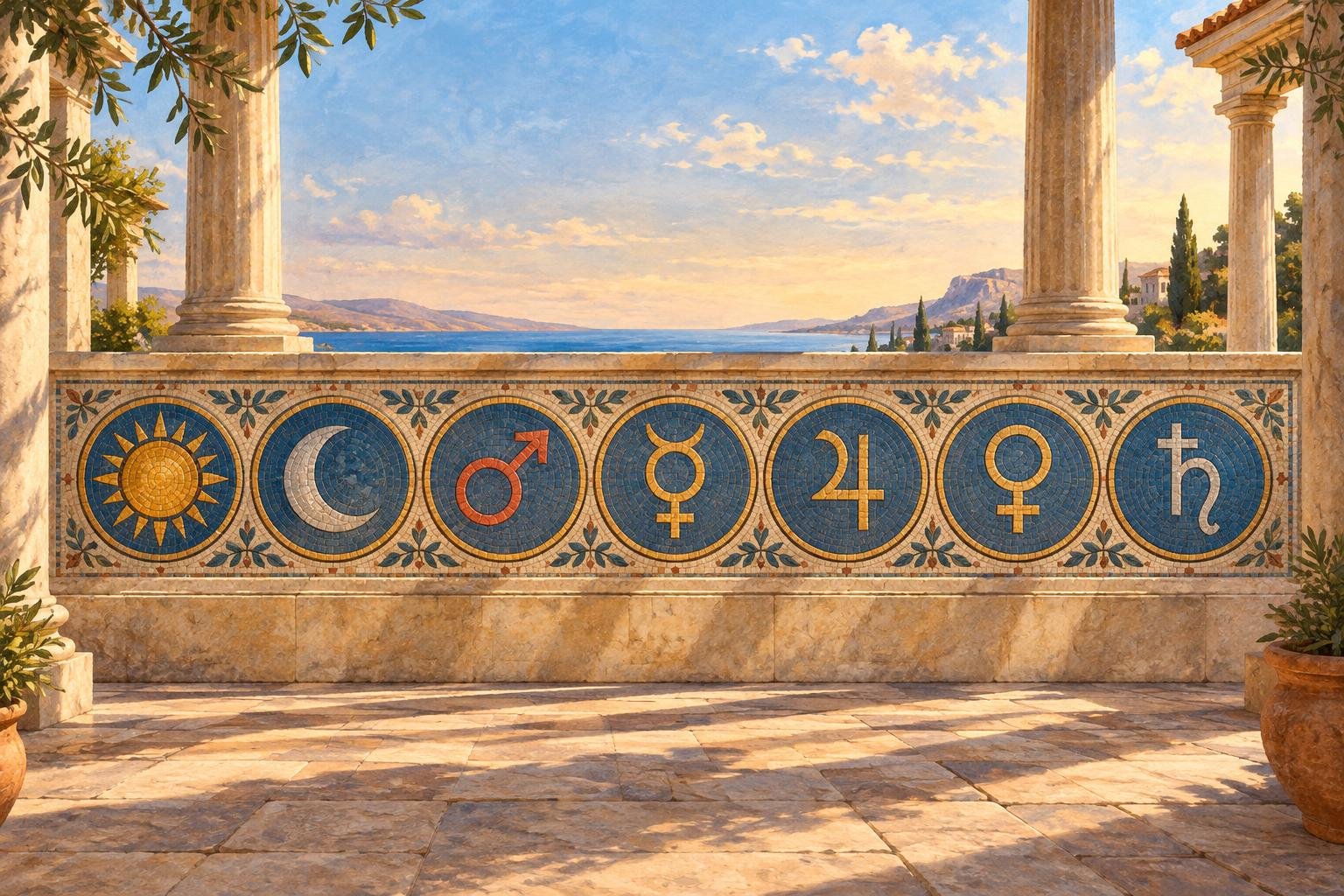
Monday carries the Moon; Saturday still bears Saturn’s name. Your weekly diary preserves an old astrological map of the heavens, with seven days assigned to seven traditional planets. Between those two familiar names, English adds a Germanic cast: Tiw, Woden, Thor and Frigg. The calendar has kept remarkably good records.
Why the Sun and Moon counted as planets
For an ancient astrologer, the seven planets were the Sun, Moon, Mercury, Venus, Mars, Jupiter and Saturn. The traditional grouping followed their movement through the sky as seen from Earth, against the background of the fixed stars.
That explains why the Sun and Moon belong in this company. When you meet the “seven planets” in an older astrological text, these are the seven bodies it means.
Each received a day. In the familiar sequence beginning with Sunday, the assignments run:
- Sunday — Sun
- Monday — Moon
- Tuesday — Mars
- Wednesday — Mercury
- Thursday — Jupiter
- Friday — Venus
- Saturday — Saturn
The names preserve the assignments even where the original planetary god has been replaced.
Rome spread the planetary week
Research at University College London places the appearance of the planetary seven-day week in Roman settings in the second half of the first century BCE. By the fourth century CE, the seven-day rhythm had spread across the Roman Empire.
Rome helped carry this system over a vast territory. Its history also ran alongside the biblical seven-day week, with its sequence of numbered days and Sabbath. These were distinct traditions that eventually shared the same weekly rhythm. Giving Rome sole credit for inventing the week would erase half the story.
The planetary tradition supplied something particularly durable: memorable names. A day belonged to a heavenly body, and that body bore a divine name. Languages could carry the arrangement forward even while changing the gods.
Cassius Dio found an order behind the sequence
Why does the Moon’s day follow the Sun’s, with Mars next? The sequence looks peculiar if you expect a simple list of planets.
The Roman historian Cassius Dio discussed the custom of assigning days to the seven planets in Book 37 of his Roman History. He connected their sequence with the accepted arrangement of the heavenly spheres and described explanations for deriving the order of the days.
His account gives us a revealing historical witness. The weekly sequence belonged to an organised picture of the heavens: planetary order could structure time on Earth as well as the sky above it. The ordinary act of naming a day carried that cosmology into daily speech.
Mars became Tiw, Jupiter became Thor
As the names passed into Germanic languages, several Roman gods acquired local counterparts. English still shows the substitutions:
- Tuesday preserves Tiw, related to the Norse Týr, in the place occupied by Mars.
- Wednesday preserves Woden, corresponding to Odin, in Mercury’s place.
- Thursday names Thor, who took Jupiter’s place.
- Friday preserves Frigg in the position held by Venus.
French makes the Roman side easier to recognise: mardi, mercredi, jeudi and vendredi retain traces of Mars, Mercury, Jupiter and Venus. English takes a different route through the same planetary week.
For Friday, the Old English dictionary entry Frig-dæg provides a particularly clear link: Frigg’s day corresponds to the Latin dies Veneris, Venus’s day. Frigg deserves her own name here; substituting Freyja blurs the evidence.
Wednesday changes character across languages
The German Mittwoch simply means “midweek”. Where English remembers Woden, German marks a position in the calendar. European languages preserved different pieces of the inheritance.
Try putting Wednesday, mercredi and Mittwoch side by side in your diary. One remembers a Germanic god, one retains Mercury, and one tells you where you stand in the week. Three ordinary words carry three different histories of the same day.
Sources
This article has been editorially reviewed
This article has been checked for factual accuracy, language quality and compliance with editorial standards.
 Victor, Virtual astrologer