
One sign, three decans
A decan is a ten-degree section of the zodiac. Each sign contains three decans, and the complete system comprises 36. These are the divisions described by Marco Bertozzi in his introduction to reading the decans—not a separate set of signs, but a finer subdivision within them.
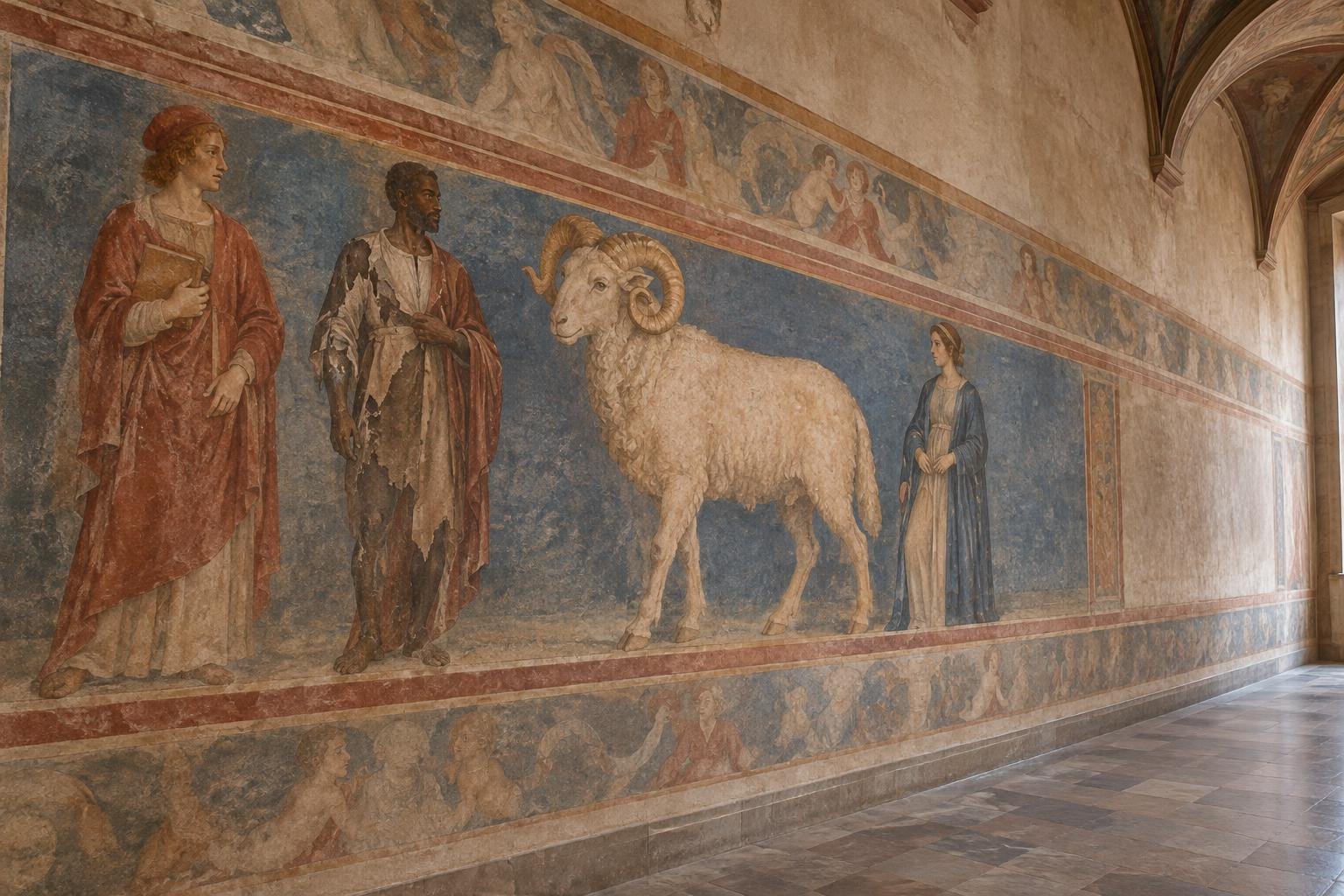
That definition becomes easier to grasp when you encounter it in a picture. In the March fresco at Palazzo Schifanoia in Ferrara, Italy, Aries appears as a recognisable ram. Yet the animal is not alone: three human figures accompany the sign in the fresco’s astrological band. They represent its decans.
Why give sections of the zodiac human faces and historical clothing? Because, in this tradition, a decan has more than a position. It also has an image, with meanings inherited through astrological texts and their interpretation. The ram provides our way into the scene; its companions invite a closer look.
Finding the astrology on the wall
The fresco cycle in the palace’s Salone dei Mesi, or Hall of the Months, was created in 1469–1470 within the courtly culture of Borso d’Este. For our purposes, the most useful thing to know is how its monthly scenes are arranged.
The museum’s account and Manuela Incerti’s study distinguish three horizontal bands:
- At the top: the triumph of a protective deity.
- In the middle: a zodiac sign accompanied by its decans.
- At the bottom: courtly scenes celebrating Borso d’Este’s rule.
This layout matters because not every person painted near a zodiac sign belongs to the same kind of scene. A court figure in the lower band and a decan figure in the middle band have different roles, even though both take human form.
Start with the middle band rather than trying to explain the whole wall at once. Locate the zodiac animal, then look for its companions. This gives you a manageable astrological unit: one sign and its three subdivisions.
Aries and its three companions
Francesco del Cossa’s March offers a particularly clear example. The ram represents Aries; the three accompanying human figures represent the sign’s decans. The animal and the people are not competing versions of Aries. They belong to different levels of the same arrangement.
There is also a small but important complication in how you follow the sequence. Incerti notes that the months and zodiac signs progress from right to left, while the decans within an individual field are read from left to right. Following the wider cycle does not automatically tell you the order of the figures inside it.
Think of this as changing the scale of your reading. First you identify the sign’s place in the cycle. Then you examine the divisions within that sign, following their own direction.
Bertozzi explains that decan images are not merely markers for sections of the zodiac. They carry mythological meanings too. His discussion draws on different forms of the astrological tradition, including Albumasar’s work and its transmission in Latin. The figures therefore reward more than visual recognition: understanding them also means tracing the texts and interpretations behind their appearance.
A figure whose identity needs a source
One companion in March is a dark-skinned man in torn clothing. His appearance is distinctive, but appearance alone does not explain his astrological role.
The museum’s interpretation connects him with the historical figure termed vir niger, Latin for “black man”, and with the tradition of interpreting the constellation Perseus. That connection should remain clearly attributed: it is the museum’s account of an iconographic interpretation, not an identity we can establish simply by looking at his clothes or skin colour.
The distinction is useful whenever an unfamiliar figure appears in an astrological image. Description answers one question: what can we see? Interpretation answers another: which inherited figure or tradition might those details represent?
Moving between the two requires evidence. Torn clothing, for instance, is a visible feature; its place in an astrological tradition needs explanation from sources. It is not a ready-made statement about the temperament of someone born under Aries.
Why Warburg’s reading mattered
The museum recalls that Aby Warburg clarified the figures’ astrological significance in 1912. They had previously been understood as moral allegories.
That change of interpretation shows how much depends on recognising the right framework. A person painted on a Renaissance wall might initially suggest a virtue, a vice or another moral idea. Recognising a decan instead places that figure within a particular division of the zodiac and opens a different set of questions.
The important shift is from asking only what a figure seems to express to asking where it belongs in the astrological scheme. The ram, the three companions and their position in the middle band work together. None needs to be interpreted in isolation.
What to take back to your zodiac reading
The Schifanoia example leaves us with three useful distinctions:
- The sign: Aries, represented here by the ram.
- The subdivision: the three decans belonging to Aries.
- The historical image: the particular figure used to represent each decan, carrying inherited mythological associations.
Keeping these layers separate makes the zodiac richer without making it harder to navigate. You can recognise Aries before understanding every companion, then investigate the details without turning them immediately into personality labels.
If you are an Aries reader, the fresco offers something more interesting than three illustrated character types. It shows how much astrological imagery can sit within a single familiar sign. The best starting point is not “Which of these people am I?” but “What role does each figure have, and how has that role been identified?”
Sources
This article has been editorially reviewed
This article has been checked for factual accuracy, language quality and compliance with editorial standards.
 Victor, Virtual astrologer