
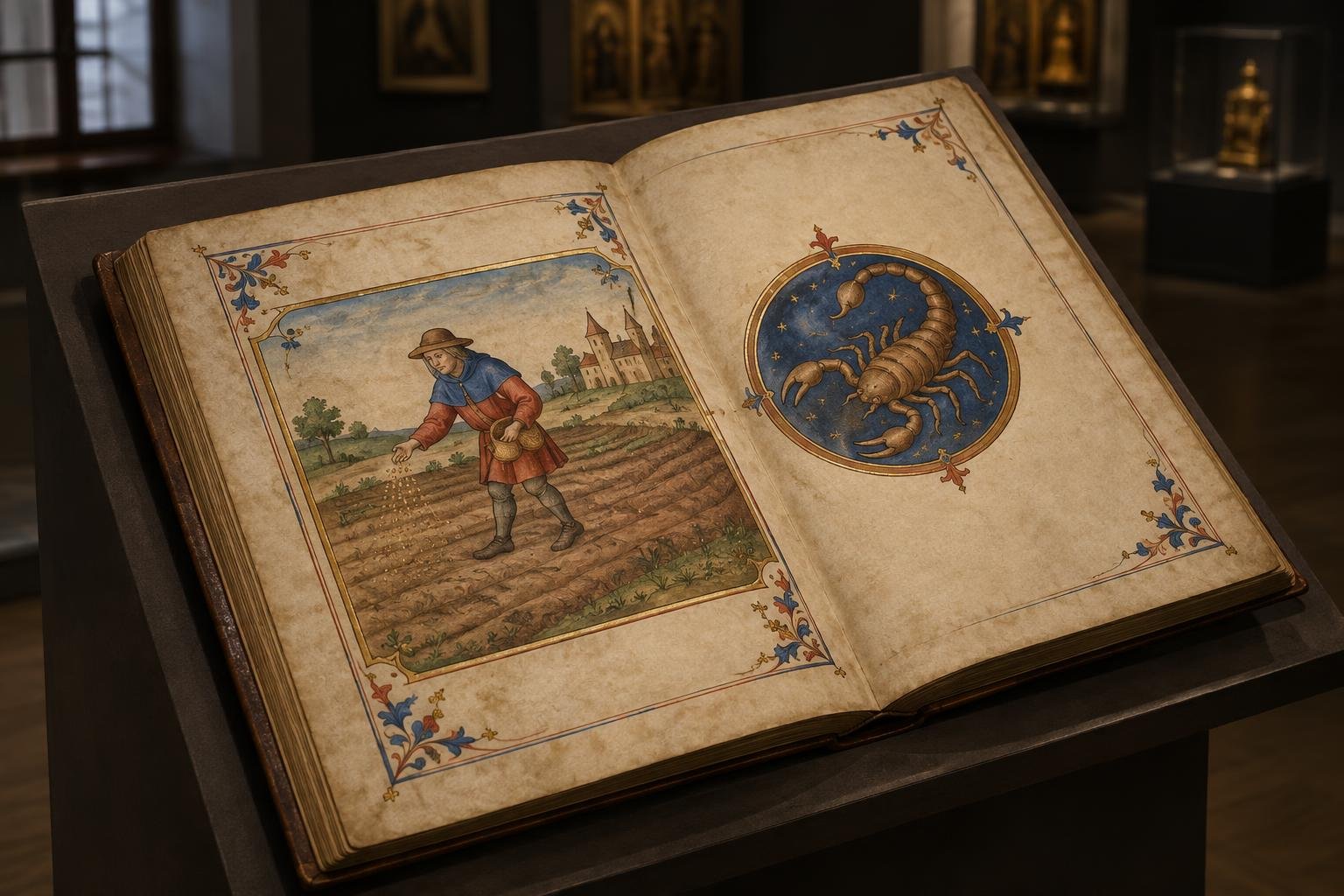
A sower beside Scorpio
A figure sowing seed and the sign of Scorpio: together, they make an intriguing portrait of October. For anyone familiar with the zodiac through birth charts, this pairing opens a different view of the signs—as companions to the changing work and observances of the year.
One particularly useful example survives in the Getty collection. Its catalogue title is wonderfully direct: Calendar Page for October; Sowing; Scorpio. The leaf belongs to manuscript Ms. 2 (84.ML.67), folio 10. Attributed to the Master of the Lee Hours, it dates to about 1450–1455 and was probably made in Ghent.
Here, seasonal activity and a zodiac sign belong to the same calendar page. But what relationship does that establish? Does Scorpio identify a part of the year, explain the work, or tell the reader when to sow?
The page gives us a firm starting point: sowing and Scorpio were brought together in the visual presentation of October. Understanding that pairing means looking at the kind of book it inhabited—and at how other medieval calendars arranged the zodiac.
The zodiac within a book of hours
Books of hours contained prayers and readings for use through the day and across the year. A calendar in such a book helped place that devotional life within the annual cycle.
Its imagery could bring several ways of recognising time together. A month had its calendar entries and religious observances; it could also have a characteristic activity and a zodiac sign. The seasonal scene and the sign offered different ways to picture the same stretch of the year.
The activities are often called the “labours of the months”. In October, sowing could provide the recognisable human action, while Scorpio supplied the zodiacal counterpart. Read together, they linked the familiar world of work with the ordered cycle of the signs.
For an astrology reader, this is a valuable shift of perspective. Instead of asking what Scorpio describes in a personality, we can ask what role it plays on a page. Here, the sign helps give the month its place within a larger annual pattern.
There is an important detail to retain: a sign assigned to a monthly illustration is not a timestamp for the Sun’s entry into that sign. The October image is part of a calendar’s visual scheme, not a precise record of an ingress.
A calendar that unfolds
The connection becomes especially tangible in a folding almanac held by the Royal Society. Catalogued as MS/45 and dated to about 1383–1400, it brings signs, seasonal tasks and religious observances together through its physical construction.
The almanac alternates zodiac signs with corresponding monthly activities. These paired images can be lifted to reveal the liturgical calendar for the relevant month.
That action matters. The relationship is not simply something a modern viewer notices between neighbouring pictures. The object itself invites its user to move between the zodiac, the work of the season and the church calendar.
Imagine following that sequence: first recognising a sign and an activity, then unfolding the section to consult the month’s religious entries. Each layer gives access to another aspect of the year. The zodiac is neither an isolated decoration nor a separate personality guide; it participates in the way the calendar is organised and used.
This makes the almanac a particularly vivid companion to the Getty October leaf. One shows the pairing on a manuscript page; the other makes the relationship something the reader handles.
One October, more than one seasonal picture
Sowing appears in another October example identified by Getty: October; Sowing, from the manuscript it calls the Bedford Book of Hours. This leaf, Ms. Ludwig IX 6 (83.ML.102), folio 10, is attributed to the workshop of the Bedford Master and dated to about 1440–1450.
It provides a second example of sowing as an October subject. Yet October did not have a single, unchanging agricultural image. Getty’s broader discussion of calendar imagery also associates October and Scorpio with treading grapes.
That variety enriches the zodiac’s calendar setting. A recurring sign could sit alongside different pictures of seasonal work. We should therefore resist turning one manuscript’s pairing into a working timetable for the whole of medieval Europe.
Local context can help, provided we preserve its uncertainties. The Royal Society catalogue suggests possible connections between its almanac and southern England. The feasts recorded may point towards London or Kent, while the arrangement of agricultural activities is described as fitting the region’s mild climate.
Those are useful clues to the object’s possible setting. They are not a certain place of manufacture, nor a record of what every local farmer did. The strongest reading keeps the layers distinct: the activity shown, the possible regional context, and any explicit instruction the manuscript actually supplies.
Three questions to ask an old zodiac calendar
You do not need specialist training to begin looking more closely. These three questions offer a practical route into a manuscript page.
What does it actually show?
Start with the visible subjects and the catalogue identification. On the Getty October leaf, the documented pairing is sowing and Scorpio. In the Royal Society almanac, signs and monthly activities connect with a calendar revealed by unfolding.
What context is being suggested?
Notice words such as “probably”, “possible” and “about”. Probable Ghent origins and possible southern English connections help situate the objects without making their histories more certain than the evidence allows.
Is there an explicit astrological recommendation?
A picture of sowing beside Scorpio does not, on its own, say to sow under a particular planetary position. That would require an instruction establishing the connection.
The pairing is already meaningful without adding one. These calendars show the zodiac woven into the recognition of seasons, work and religious observance. Looking at Scorpio beside a sower, we encounter a sign doing something beyond describing a person: helping a reader picture their place in the year.