
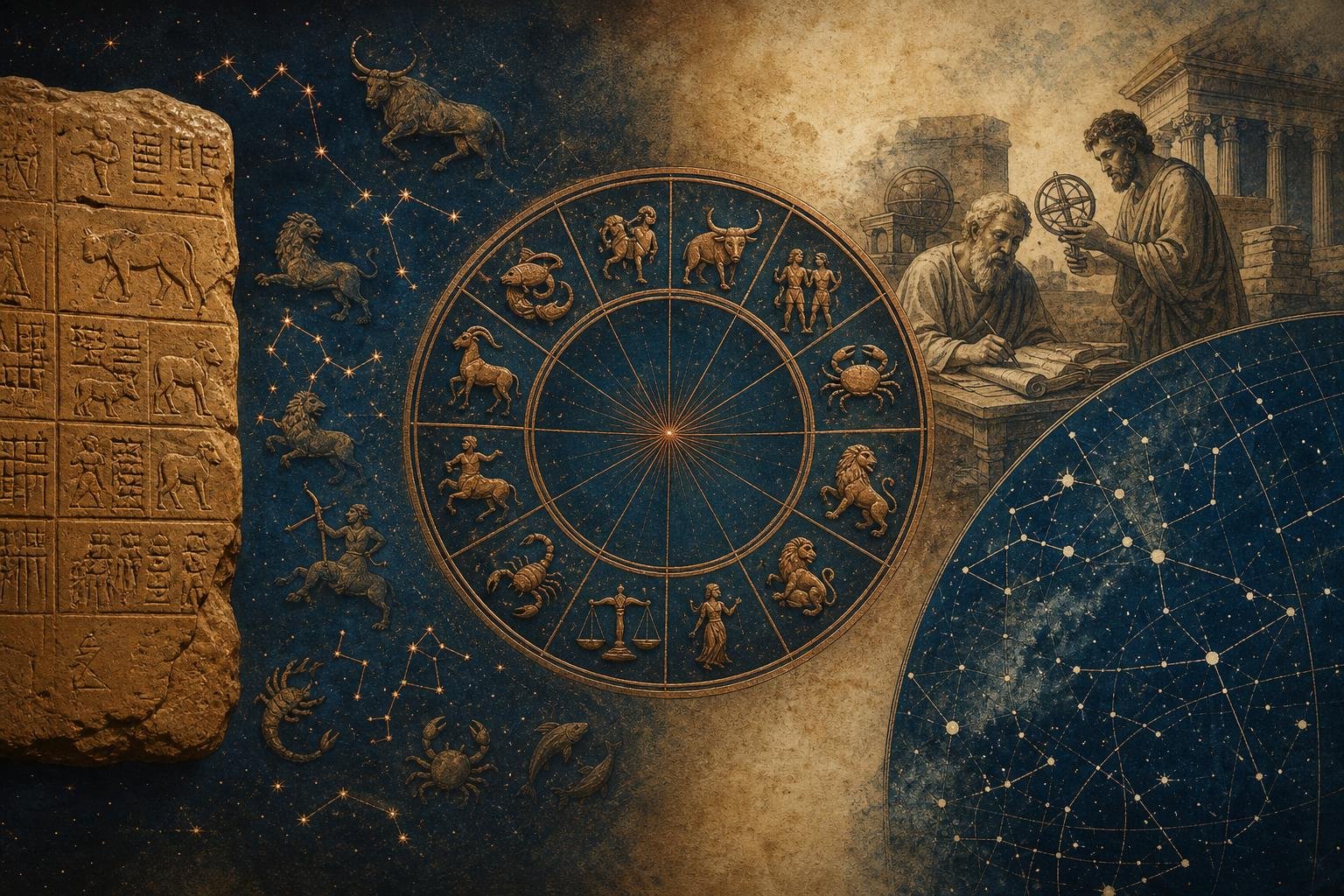
First came the star figures
Long before the zodiac became a circle of twelve equal signs, Mesopotamian scholars were cataloguing and organising the night sky. One important record of this older tradition is the work known as MUL.APIN, preserved on cuneiform tablets. It lists stars and constellations and arranges celestial phenomena into systems useful for observation and timekeeping.
Among its contents is a group of constellations in the “path of the Moon”—the region through which the Moon, Sun and visible planets appear to travel. This may sound like the zodiac in its modern form, but there is a crucial difference. The list contained seventeen constellations, not twelve signs, and those star figures did not form geometrically equal sections of a circle.
The distinction matters because the zodiac was not simply waiting in the sky to be discovered as a complete system. The visible stars supplied patterns, names and reference points. The regular twelve-part structure came later.
The Babylonian move towards a regular circle
The uniform zodiac developed in Babylonia by the end of the fifth century BCE. Its exact date of origin is unknown, and no surviving source identifies a single inventor. The evidence instead reveals the emergence of a mathematical framework for recording and calculating the positions of the Moon, Sun and planets.
In this system, the celestial path was divided into twelve consecutive signs, each measuring 30 degrees. Together they completed the 360-degree circle. Unlike constellations, these signs had identical dimensions and followed one another without gaps.
That regularity made it possible to state a planet’s position within a standard sector rather than describe it only in relation to an irregular star figure. The result was an abstract coordinate system: it drew its names and imagery from the observed sky but did not reproduce the constellations exactly.
This is also why the zodiac’s history cannot be reduced to a story about discarding an unwanted “thirteenth sign”. The older list in the path of the Moon and the later twelve-sign zodiac were different kinds of system. One catalogued star figures; the other divided a circle into equal mathematical units.
Why were there twelve signs?
A widely accepted explanation connects the zodiac with a schematic calendar consisting of twelve 30-day months. Twelve equal signs of 30 degrees each produce a 360-degree circle, just as twelve idealised months of 30 days produce a 360-day year.
This was a regular numerical scheme rather than a precise representation of the solar year. Its value lay in providing a consistent structure for calculation.
Nor do we possess a document in which a named creator announces that the sky will be divided this way because of the calendar. The connection is a historical interpretation based on the organisation of these mathematical systems. The surviving evidence points more strongly towards gradual development than towards one documented moment of invention.
How the signs acquired their names and order
The equal sectors still needed names. Babylonian scholars drew on an existing repertoire of constellations, selecting and adapting familiar celestial figures for the new framework. The process was not a matter of taking the seventeen older constellations and removing five. A new, uniform grid was created, and its sections received names rooted in earlier traditions of mapping the sky.
Some Babylonian names do not map neatly onto their modern English counterparts. Historical sources include figures conventionally rendered as the Hired Man, the Stars, the Furrow, Pabilsag, the Goat-fish, the Great One and the Tails. Through cultural transmission and reinterpretation, these became associated with forms recognisable in the later zodiac, including Aries, Taurus, Virgo, Sagittarius, Capricorn, Aquarius and Pisces.
By the final centuries BCE, sources attest an order corresponding to the familiar sequence: Aries, Taurus, Gemini, Cancer, Leo, Virgo, Libra, Scorpio, Sagittarius, Capricorn, Aquarius and Pisces. Mathematical texts numbered the signs beginning with Aries.
The familiar order therefore preserves a historical line of transmission, but not a set of images whose meanings and translations remained unchanged. Names passed between languages and scholarly cultures, while some figures were reinterpreted along the way.
The zodiac enters Greek scholarship
Greek scholars received the zodiac as an established system of twelve equal sections rather than creating that structure from scratch. They incorporated it into their own astronomy and later astrological writing.
Geminos, writing in the first century BCE, provides especially useful evidence because he explicitly distinguished 30-degree zodiac signs from the visible constellations bearing related names. Ancient scholars were therefore already aware that a mathematical sign and a star figure were not identical.
Geminos also recorded a difference in convention. Babylonian scholars—the “Chaldeans” in his account—placed the equinoxes and solstices within the relevant signs. Greek astronomers placed these seasonal points at the beginnings of Aries, Cancer, Libra and Capricorn. Even after the twelve-part framework had travelled westward, its conventions continued to develop.
The zodiac used today is consequently not the untouched product of one civilisation. It emerged through successive stages: Mesopotamian observation and cataloguing, Babylonian mathematical standardisation, and transmission into Greek and later intellectual traditions.
A sign is not a constellation
The clearest way to understand the difference is to imagine two maps laid over the same region of sky.
The first is the zodiacal circle: twelve adjacent sectors, each exactly 30 degrees wide. In astrology, these equal signs form an interpretive framework and carry symbolic associations accumulated over centuries.
The second is the modern astronomical map. Its constellations have officially defined boundaries, and their areas differ in shape and size. The Sun therefore does not spend an equal amount of time within each astronomical constellation. These are regions of the sky, not twelve identical pieces of a geometric wheel.
The two maps share names and a long historical relationship, but they serve different purposes. Confusing them obscures the most interesting part of the story: the zodiac was a deliberate act of mathematical organisation, built from older observations without being identical to them.
Its astrological meanings belong to an interpretive tradition; their historical longevity does not constitute scientific evidence that signs cause human events. What history can show is how scholars transformed an irregular landscape of stars into a portable and remarkably durable system of twelve equal signs.