
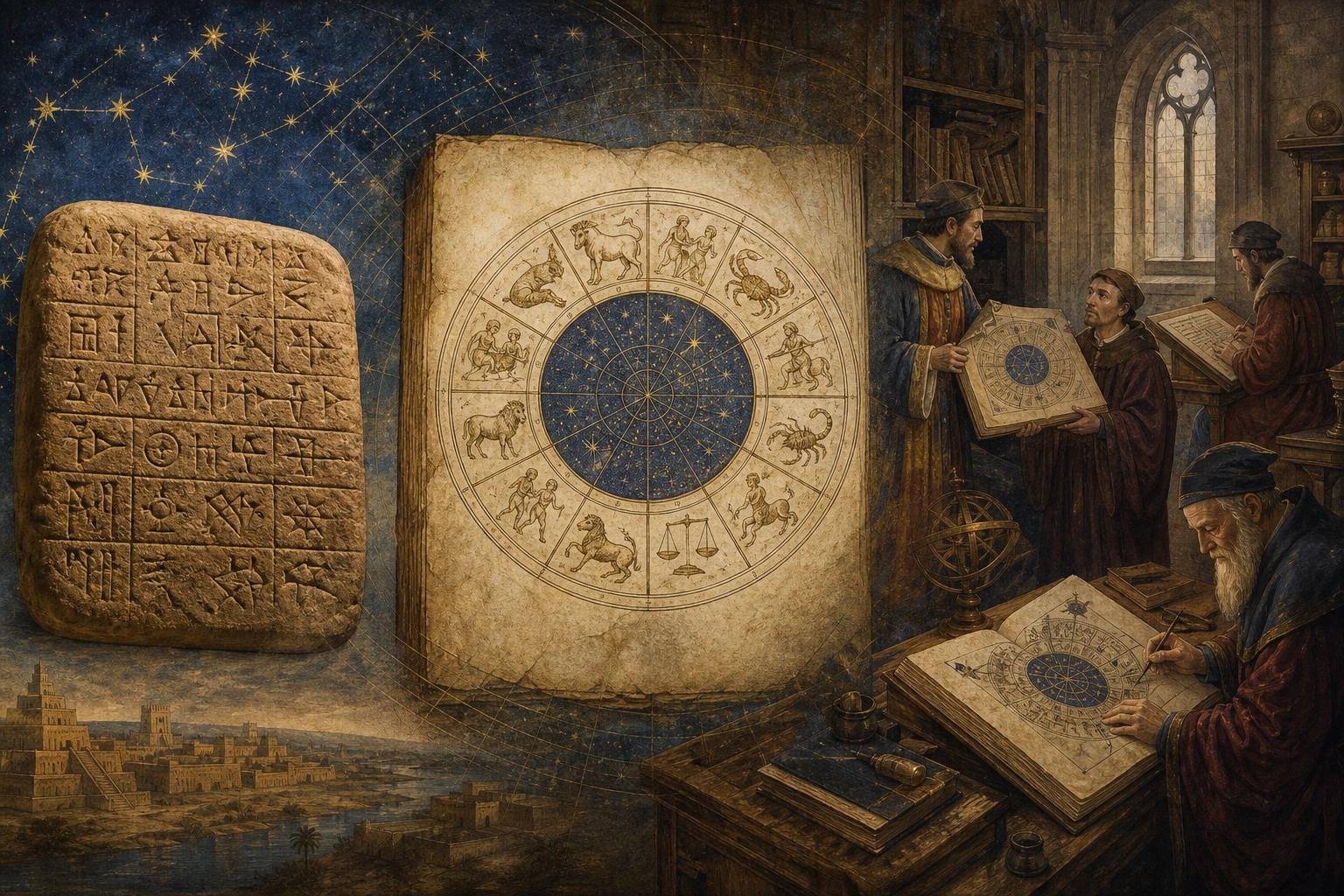
The twelve signs can look like a finished set that has always existed in its familiar form: Aries followed by Taurus, then Gemini, and so on until Pisces completes the circle. The surviving evidence tells a more complicated story. Names, celestial figures, mathematical divisions and interpretive ideas accumulated over centuries, moving between languages and scholarly settings.
There was no single inventor of the zodiac, nor one uninterrupted route from an ancient source to modern astrology. What remains are individual witnesses to different stages: a Babylonian tablet, a Greek treatise, an early medieval illustrated manuscript and a later Castilian translation project. Together, they show a system repeatedly refined, preserved and reinterpreted.
A Mesopotamian foundation still taking shape
A late Babylonian clay tablet, dated to around 500 BCE, connects the twelve months with celestial figures associated with the zodiac. Several are recognisable as predecessors of names still used today: the Bull, the Great Twins, the Crab, the Lion, the Scales, the Scorpion and a goat-fish figure related to Capricorn.
Recognition does not mean exact identity. Ancient names do not always map neatly onto their modern English equivalents, and the objects represented could carry associations that later changed or disappeared. The tablet is especially revealing because some months are linked with more than one celestial figure. Rather than presenting a perfectly fixed list, it preserves signs of a classification still being consolidated.
This matters because historical summaries can make the zodiac sound as though twelve pictures were chosen at a single moment and then handed down unchanged. The evidence instead suggests gradual standardisation. Earlier observations, calendars and star traditions provided material that could be grouped, named and aligned with a twelve-part cycle. Different labels could coexist before one arrangement became dominant.
In Greek, the zodiac becomes a systematic circle
By the second century CE, Claudius Ptolemy’s Greek-language Tetrabiblos describes a much more systematic structure. Its zodiac consists of twelve equal sections of 30 degrees, ordered from Aries through Pisces. The principal starting points are connected with the equinoxes and solstices.
That geometrical organisation is important. A zodiacal sign in this framework is not simply the visible outline of a constellation. It is one equal sector within a measured circle. Constellations vary in size and shape; the signs of the system do not. This distinction helped make the zodiac suitable for calculation as well as interpretation.
Ptolemy discusses all twelve signs individually and places them within an organised body of astrological thought. He did not invent the zodiac. His work instead demonstrates that a complete set of signs and categories was already available in the Greek-speaking world and could be described in a coherent technical text.
The Tetrabiblos is therefore better understood as a major witness to systematisation than as an origin story. Between the Babylonian list and Ptolemy’s account lie centuries of exchange, adaptation and intellectual work. The surviving examples illuminate points along that history, but they do not preserve every step.
Medieval Europe preserved more than words
Transmission did not depend only on abstract definitions. Images mattered too. A Latin manuscript produced in Salzburg around 818 contains constellation illustrations and other astronomical material based on late antique models. It shows that medieval European scribes were copying and preserving an inherited visual repertoire of the sky.
Such a manuscript could carry recognisable celestial characters across generations even when artistic style, language and scholarly context changed. A lion, twins or a scorpion was not merely a label in a list; it could also be a figure redrawn on parchment and placed within a larger account of the heavens.
The Salzburg manuscript should not, however, be treated as proof of every link between antiquity and the ninth century. It is one concrete example of preservation, not a complete map of transmission. Manuscripts could be copied from now-lost exemplars, combined with other texts or altered to suit new readers. What survives is only a fraction of what once circulated.
Translation created several routes into Europe
Another route is visible in the Castilian Libros del saber de astronomía, or Books of the Wisdom of Astronomy, compiled between 1276 and 1279. The collection includes material on the celestial spheres and signs of the zodiac. It emerged through translations from Arabic and Aramaic sources involving Jewish, Christian and Muslim scholars.
This collaborative setting challenges the idea that ancient knowledge simply travelled west along one straight line. Translation was an active intellectual process. Translators had to select terminology, reconcile concepts and make specialised material intelligible in another language. Copyists, patrons, commentators and illustrators also shaped what later readers received.
Latin copies of late antique material and Castilian translations drawing on Arabic and Aramaic sources represent different strands of preservation. They need not form consecutive stops on one journey. Medieval Europe encountered celestial traditions through multiple networks, with knowledge moving around the Mediterranean and across linguistic boundaries in more than one direction.
What survived—and what changed
The strongest continuity lies in the twelve-part sequence and in many of its central images. Bulls, twins, lions, scales and fish remain familiar, even though their names, visual treatment and meanings have varied. The equal division into twelve 30-degree signs also became fundamental to the form of the zodiac used in later European astrology.
Yet continuity should not be mistaken for immobility. A Babylonian month-name, a Greek geometrical sector, an illustrated constellation and a medieval translated category are related, but they are not interchangeable. Each belongs to a particular language, purpose and historical setting.
It is also useful to distinguish the description and cataloguing of the sky from astrological interpretation. For much of this history, the two occupied overlapping scholarly environments and shared calculations, manuscripts and terminology. Today, astronomy studies celestial objects and motions scientifically, while astrology remains an interpretive tradition rather than a scientifically demonstrated mechanism by which celestial bodies cause human events.
The modern zodiac is therefore less like an artefact made by one hand than a manuscript repeatedly copied in the margins of history. Its familiar order emerged from long processes of classification, measurement, illustration and translation. No single surviving source contains the whole story—and no single culture can credibly claim the entire system as its work.