
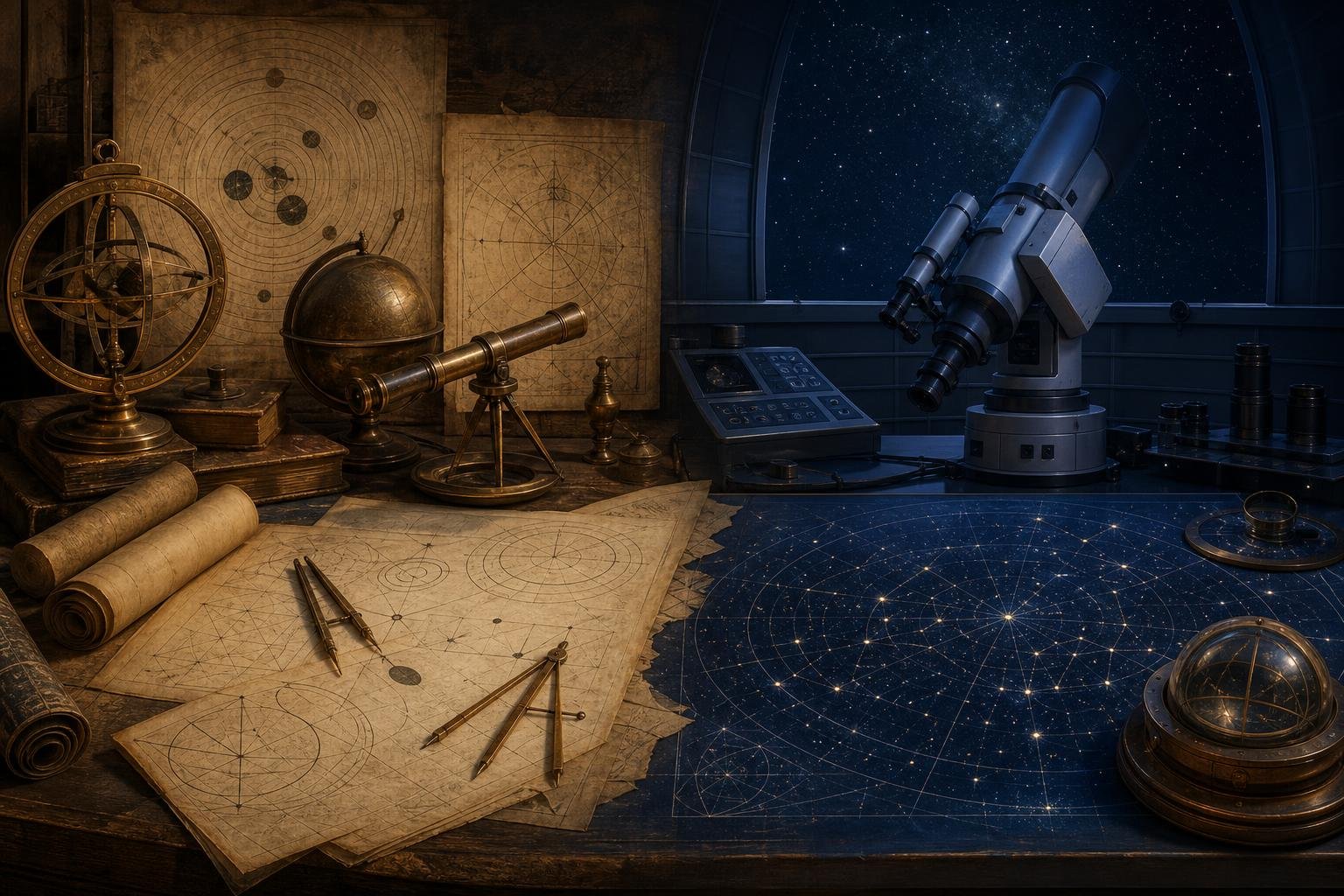
For much of European history, observing the sky, calculating planetary positions and interpreting their significance belonged to an interconnected field of learning. The sharp boundary familiar today emerged only gradually.
That is why the separation of astronomy and astrology cannot be assigned to one discovery, one thinker or one decisive year. Even the words themselves changed meaning over time and were sometimes used interchangeably. What mattered was not simply a new picture of the cosmos, but a long shift in the questions scholars asked, the evidence they accepted and the institutions that supported their work.
Antiquity to the Renaissance: shared tools, different purposes
Earlier scholars did not necessarily recognise astronomy and astrology as the distinct disciplines we know today. Both depended on careful observations of the sky and mathematical methods for calculating the apparent positions of celestial bodies.
In medieval and Renaissance Europe, this knowledge supported several activities at once. It helped with calendars and timekeeping, contributed to natural philosophy and supplied the calculations used in astrological texts. Astrology also had a place within university learning rather than existing wholly outside educated culture.
The important distinction was already present in practice, even if it was not yet an institutional boundary. Calculating where a planet appeared in the sky was one task; assigning meaning to that position was another. The same tables and measurements could serve both.
This shared technical foundation helps explain why applying today’s categories too rigidly to the past creates confusion. A scholar could be an exacting observer and mathematician while also accepting forms of interpretation that modern astronomy excludes.
The heliocentric model did not end astrology
It is tempting to identify heliocentrism as the moment when astronomy became modern and astrology was left behind. The history is less tidy.
Placing the Sun rather than Earth at the centre of a planetary model transformed the understanding of cosmic order. But it did not automatically prevent astrologers from continuing their work. Many astrological procedures relied on the apparent positions of celestial bodies as seen from Earth, and those positions could still be calculated within a new astronomical framework.
Some early supporters of new cosmological models therefore continued to engage with astrology. Accepting a different arrangement of the planets did not require everyone to abandon older ideas about celestial significance at the same time.
Heliocentrism was a major change in astronomy, but it was not a switch that instantly separated two professions.
The 17th and 18th centuries: the questions begin to change
The boundary became more visible during the 17th and 18th centuries. This was not the result of a single successful objection to astrology. Several developments worked together: new observations, empirical criticism, changing ideas in natural philosophy, reassessments of ancient authorities and shifts within universities and learned institutions.
Contact with different regions of the world also posed difficulties for traditional schemes developed under particular geographic conditions. Knowledge based on one latitude or inherited climatic assumptions did not always transfer neatly elsewhere.
Comets reveal the changing priorities
Debates about comets offer a useful example. Earlier discussions could combine observations of a comet with questions about what it signified for events on Earth. Over time, investigators increasingly concentrated on the comet itself: its path, distance, motion and physical nature.
The crucial change was therefore not that people suddenly stopped noticing possible meanings. Rather, the emerging discipline of astronomy increasingly defined those questions as outside its proper field of inquiry. A comet became primarily a celestial object to measure and explain, not a message to decode.
This redefinition of legitimate questions helped create a methodological division. Astronomy focused ever more strongly on physical mechanisms and predictions that could be tested against observation. Astrological interpretation followed a separate path.
Tycho Brahe and the uneven pace of change
Tycho Brahe illustrates why the transition cannot be reduced to a simple before-and-after story. His work placed extraordinary emphasis on precise observations, improved instruments and mathematical description. At the same time, he did not immediately discard astrological ideas.
His case suggests that professional language and public presentation could change before every older belief disappeared. Precision, observation and natural-philosophical explanation gained authority, while astrological claims became less central to the emerging scholarly image of astronomy.
Tycho should not be treated as a template for all of Europe. His career was distinctive. Yet it shows how one person could participate in the making of a new astronomical discourse without fitting comfortably into either of today’s categories.
The 19th century made the boundary institutional
By the 19th century, astronomy was increasingly organised as a specialised profession with its own societies, journals, standards and research programmes.
The Astronomical Society of London, founded in 1820, promoted precise calculation, systematic observation, publication and practical applications such as navigation. In 1831 it received a royal charter and became the Royal Astronomical Society.
Neither date marks the definitive end of an older relationship between astronomy and astrology. They instead illustrate how a boundary formed over previous centuries became embedded in durable institutions. Astronomy now had professional organisations that could define accepted methods, reward particular kinds of work and shape the identity of the discipline.
The difference today is methodological
Modern astronomy studies physical objects and processes: planets, stars, galaxies, radiation, gravity and the evolution of the universe. It relies on measurement, mathematical models, reproducible observations and claims that can be tested and revised.
Astrology uses calculated celestial positions as the basis for symbolic interpretation. Its meanings belong to an interpretive tradition; they are not scientifically established causes of human events.
The two fields therefore still meet at one practical point: both may refer to positions and cycles in the sky. But calculating a position is not the same as interpreting it. Astronomy asks what celestial objects are, how they move and which physical processes explain them. Astrology asks what those calculated patterns might symbolise.
Their separation was consequently not a single historical break. It was a gradual division of aims, methods, language, professional reputation and institutional authority—one that became especially pronounced in the 17th and 18th centuries and was consolidated later.
Sources
- Reassessing the Marginalization of Astrology in the Early Modern World
- Astrology — The Cambridge History of Science
- Tycho Brahe and the Separation of Astronomy from Astrology
- Is astrology universal? Early modern globalization and the disruption of traditional knowledge
- The Early Modern Cometary Discourse as Reflected in Vernacular Tracts
- A brief history of the Royal Astronomical Society
- The Charter of the Royal Astronomical Society