
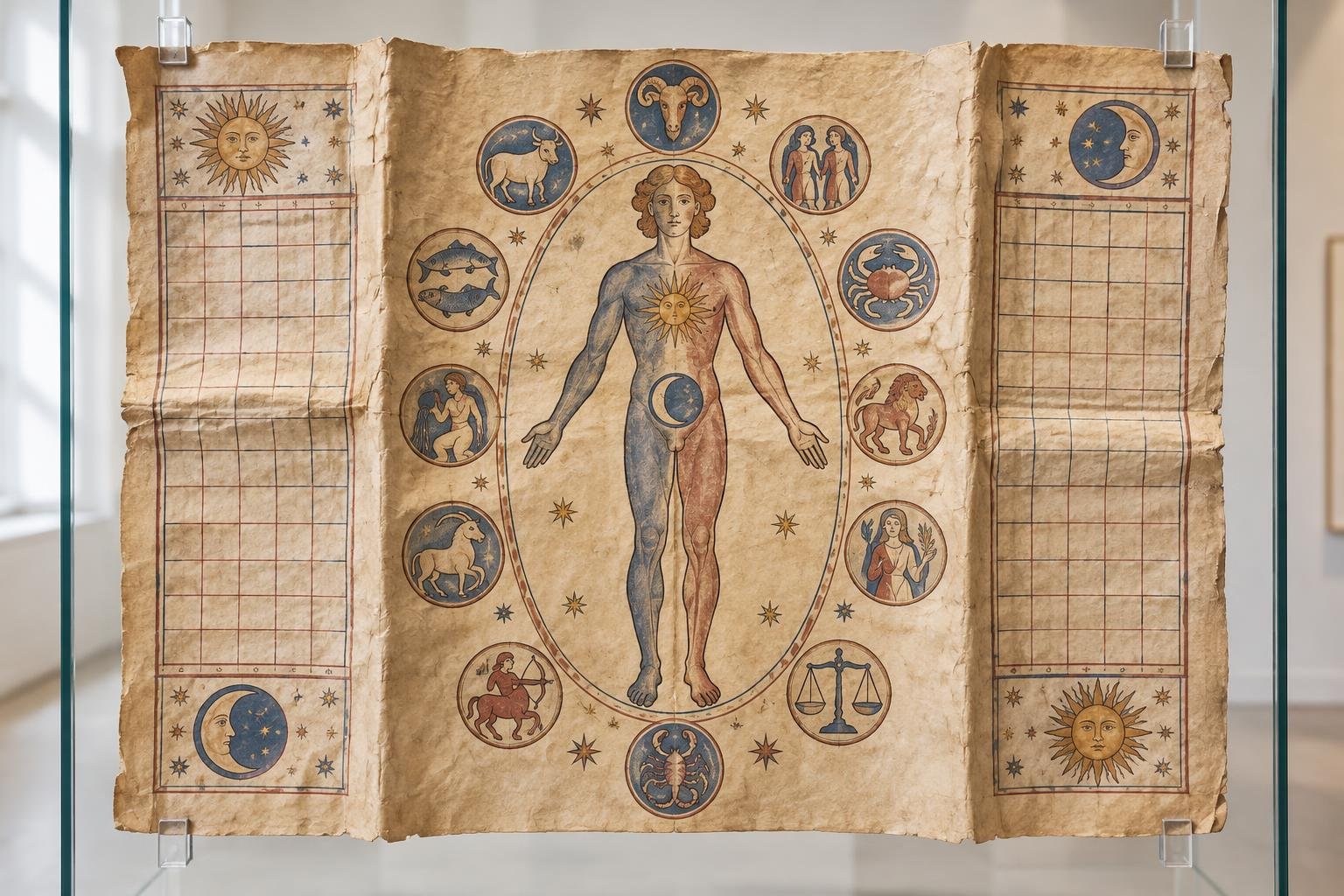
A human figure surrounded by the zodiac tells us something important about astrology’s past: its symbols once belonged in medical books as well as horoscopes. Medieval almanacs placed that figure alongside calendars and tables of celestial cycles. For readers interested in astrology’s history, these objects show how closely the tradition connected the human world with the heavens—and how much information it could pack into a small, folded reference work.
The Zodiac Man put the heavens around the body
The Wellcome Collection catalogues an image of the Zodiac Man from Johannes de Ketham’s Fasciculus Medicinae, dated 1500. The catalogue item is a photograph of a reproduction, a useful distinction when following an old image through a modern collection.
The figure belongs to a familiar tradition in medieval medical almanacs and manuscript books. Astrological tradition assigned signs of the zodiac to regions of the body, turning the human outline into an ordered arrangement of celestial correspondences. The body supplied the shape; the zodiac supplied the organising scheme.
That made the image more than an attractive border. It gave readers a compact way to recognise relationships taught by the tradition. Where a modern astrology reader might expect a circular chart, this historical reader encountered a standing figure. The human form itself carried the arrangement.
A folding almanac brought several kinds of knowledge together
Now picture the almanac folded shut. Open it, and a compact object becomes a larger reference surface. The format matters: these works brought information together in a form that could be folded down and consulted again.
Wellcome’s account of medieval folding almanacs describes a combination of calendars, lunar and solar tables, bodily imagery and material used by people working with medicine, astrology and prognostication. The Zodiac Man belonged within that larger collection of information. It did not have to explain everything on its own.
Each element performed a different job. The calendar organised dates. The celestial tables tracked cycles. The bodily figure displayed the tradition’s correspondences between the person and the zodiac. Together, they connected the question of when with an inherited account of how the human body fitted into the celestial order.
For anyone browsing a digitised manuscript, this is a useful reading habit: look beyond the striking figure. The neighbouring tables help explain why it appears there.
Galen’s name carried authority—and attracted scrutiny
Pictures and tables were only part of the story. Medical astrology also drew authority from texts associated with Galen.
Historical scholarship identifies two important foundations of his later astrological reputation: teaching about “critical days”, an inherited framework for interpreting the timing of changes during illness, and a work called Prognostica de decubitu. In the sixteenth century, the latter was identified as inauthentic.
That distinction changes the story. Later readers encountered a body of teaching assembled under an authoritative name, and questions about authorship changed how that authority could be used. Calling Galen the straightforward founder of a single, settled system would flatten a much less tidy history.
A famous name could hold a tradition together. Examining the texts beneath that name could pull parts of it apart.
Medical astrology outlasted the medieval manuscript
The history continues beyond folded parchment and early printed images. Research on the early modern period describes astrology as an optional guide within learned medicine, while medical astrology remained active outside university settings into the eighteenth century.
Its standing therefore changed unevenly. University learning, inherited textual authority and practice beyond academic institutions followed different paths. A disputed attribution in one setting did not instantly empty every almanac of its meaning elsewhere.
Those surviving objects preserve the differences. A bodily diagram records a system of correspondences; a table records the effort to organise celestial time; a text bearing Galen’s name records the weight of an authority that later readers would question. Read them side by side, and the history acquires both a human outline and a paper trail.
Sources
This article has been editorially reviewed
This article has been checked for factual accuracy, language quality and compliance with editorial standards.
 Victor, Virtual astrologer