
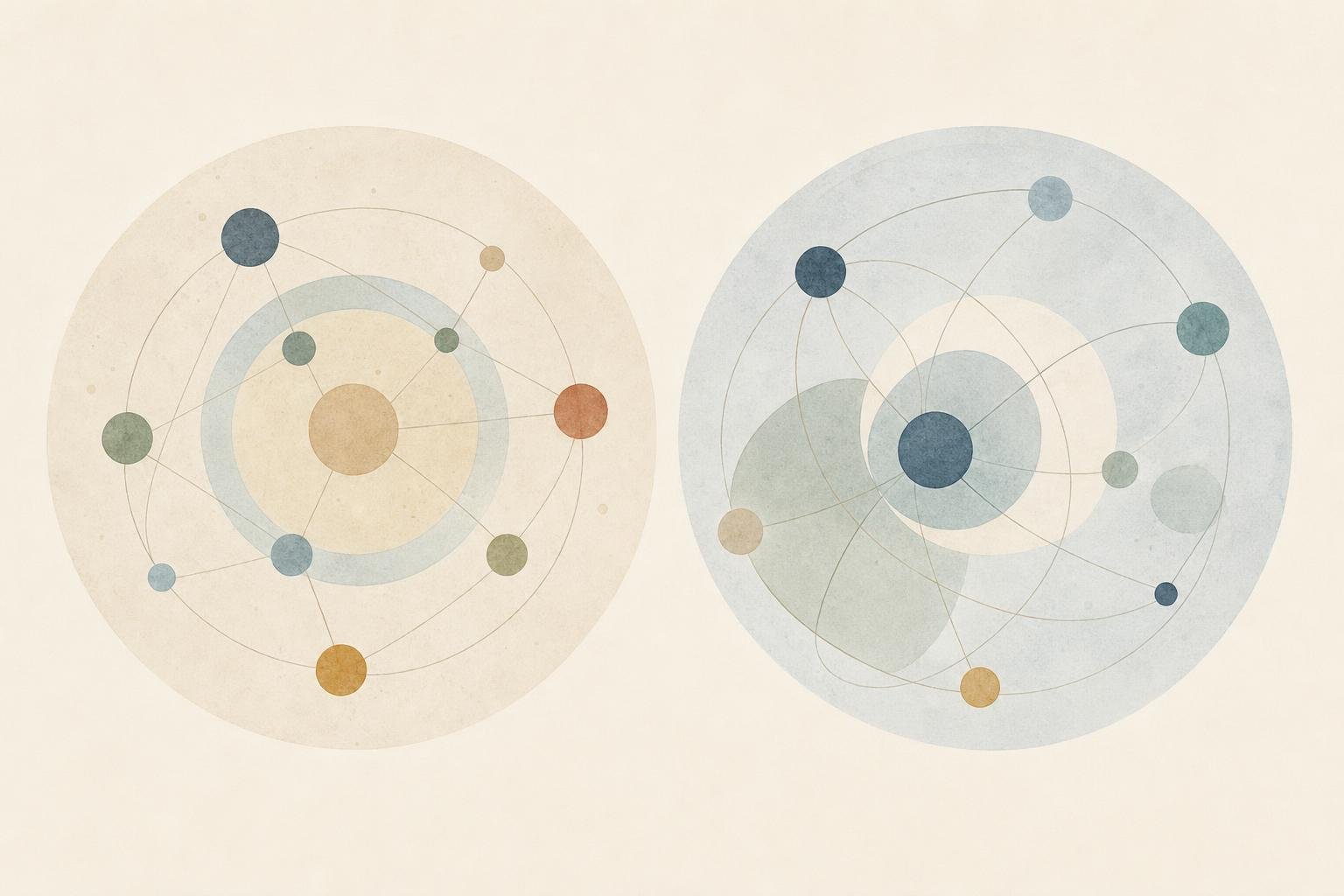
Two people bring different histories, habits and expectations to a relationship. Synastry offers one way of talking about those differences: it places their birth charts alongside each other and looks at how the planetary positions relate. What it does not offer is a pass-or-fail compatibility score.
That distinction matters when an interpretation starts to sound decisive. A chart comparison can suggest topics worth discussing, but it cannot tell you whether two people listen to each other, keep their promises or want the same kind of partnership. It also depends on the information available. If a birth time has not been verified, some familiar chart features cannot be used reliably at all.
What synastry actually compares
A birth chart maps planetary positions using a person’s birth details. Synastry compares two such charts, looking at positions within each chart and at the relationships between them. Rather than asking, “Are these two people compatible?”, a more useful question is, “What themes does this comparison bring into focus?”
An interpretation may begin with a position in one person’s chart, then examine how it relates to a position in the other’s. These connections are not descriptions of conversations the pair have actually had. They are prompts for exploring experiences the people involved might recognise—or might not.
This goes further than matching Sun signs, though it is not simply a more elaborate way to produce the same verdict. A comparison may contain several contrasting themes at once. One part of a reading does not cancel out another, and no single contact sums up a relationship. People respond to each other in context, not as isolated symbols on a page.
Planets and aspects: topics, not outcomes
One thing an astrologer looks for is an aspect: a particular angular relationship between planetary positions. In synastry, that can mean comparing a planet in one person’s chart with a planet in the other’s. The resulting pattern gives the reader something specific to discuss, rather than a score to add up.
Consider two people whose charts contain a close contact between planets. A reading might invite them to reflect on where their expectations meet and where they differ. That question is open-ended. The contact cannot establish what either person intends, how a disagreement unfolds or whether they enjoy being together. To find out, you would have to ask them.
Aspect labels can sound more conclusive than they are. Describing a contact as significant does not mean it will dominate daily life; counting several contacts does not reveal which ones the couple will notice. A lengthy list of chart features may create an impression of precision while leaving the most important question unanswered: does any of it help the people involved describe their own experience?
A thoughtful reading therefore makes room for questions. When do conversations feel straightforward? What tends to get lost in translation? Where do both people want closeness, and where might they mean different things by it? Such questions may be inspired by a comparison, but the answers come from the relationship, not from an aspect alone.
What changes when the birth time is unknown
Birth time is not a minor detail to fill in for the sake of a tidy chart. The ascendant and the house positions depend on it. Without a verified time, you cannot reliably identify that person’s ascendant or say which houses the planets occupy. You also cannot make a dependable claim about another person’s planets falling into those houses.
That rules out some common lines of synastry interpretation. A statement such as “your partner’s planet falls in your seventh house” needs a sound basis for the house positions. If that basis is missing, the statement should be left out—not presented confidently and qualified only afterwards. An unverified time should not be quietly replaced with noon to make the chart appear complete.
If one person’s birth time is known and the other’s is not, the uncertainty is not identical on both sides. You can discuss the chart features supported by the known time without pretending the missing time is known too. Any claim that depends on the untimed person’s ascendant or houses remains unsupported.
Other parts of a comparison may still be possible with reliable birth dates. They need to be described at the level the information supports, however. Some planetary positions can be more sensitive to the missing time than others; a precise contact should not be asserted when its position cannot be established confidently. A reader should be able to tell which observations rest on known details and which cannot be established.
There is no need to treat a shorter reading as a failed one. Leaving out an unsupported house interpretation is more helpful than adding detail that only looks precise.
How to read the conclusion without turning it into a verdict
A synastry reading works best when its conclusion brings the discussion back to the people involved. It might identify a question worth revisiting—how each person asks for attention, for instance—without deciding what the answer must be. Both people should have room to disagree with the interpretation or recognise different parts of it.
If you are reading a comparison of your own relationship, notice what it helps you articulate. Does a description point to a conversation you have already had? Does it flatten a difference that feels important to you? Is one person’s experience missing? These are better ways to judge a reading’s usefulness than a final label of “compatible” or “incompatible”.
No chart comparison can settle whether a relationship is worthwhile. Synastry can provide a vocabulary for looking at its dynamics, within the limits of the birth details available. The more revealing part is what happens when two people use that vocabulary to listen, question and describe their own experience.