
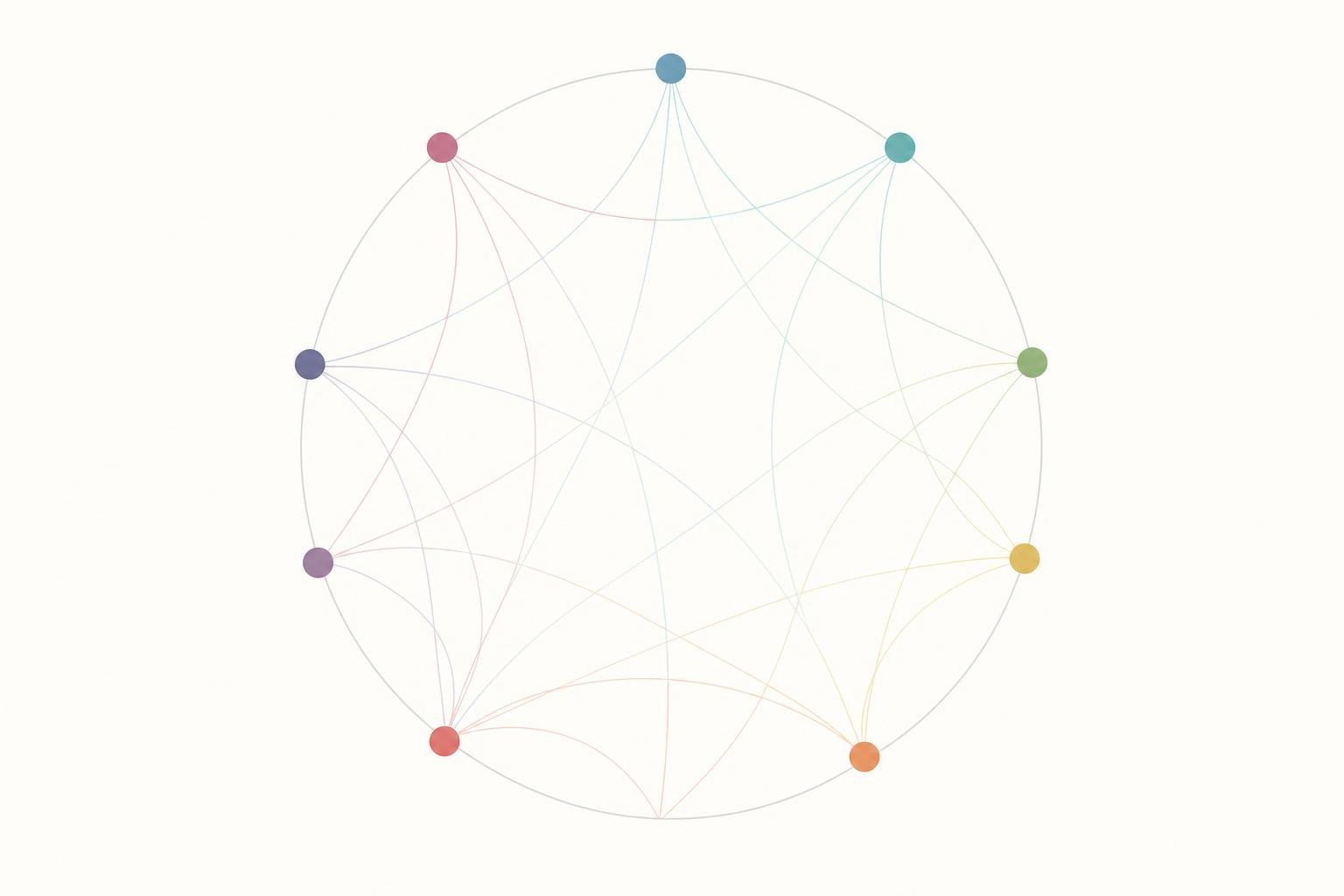
Open an astrology chart and you may find a web of lines crossing its circle. Each line marks a relationship between two positions, known as an aspect. The pattern becomes easier to follow once you know what the main aspect names describe. First, though, it helps to separate the arrangement of the positions from the meaning given to it.
What is an aspect?
A chart places planets and other points around a circle. An aspect describes a particular separation between two of those positions. The connecting line is a visual aid: it lets you spot the relationship without tracing the circle yourself.
Naming an aspect and interpreting it are different steps. “These positions form an opposition” identifies an arrangement. “This opposition brings two priorities into contrast” proposes a way to read it. That second step depends on what the positions represent and what else appears in the chart. The line alone cannot supply a complete account of a person or situation.
A useful way to learn the five main aspects is to picture familiar shapes inside the chart circle. You do not need to draw every side of each shape. Imagine where its corners would fall, then look at the link between the two positions in question.
Five aspect names worth knowing
Conjunction: positions close together
In a conjunction, two positions sit close together around the circle. There may be little room for a visible connecting line. Astrologers often discuss the elements together because their themes appear in the same part of the chart.
Closeness does not tell you whether the combination feels comfortable. Think of two voices speaking at once: they might reinforce each other, interrupt each other or simply both need to be heard. The analogy illustrates the question a conjunction can raise, not a rule about what it will do.
Opposition: facing across the circle
An opposition joins positions across the circle from one another. Picture a line passing through the middle of a wheel, linking opposite points on its rim. It is a straightforward pattern to recognise, even when the chart contains many other lines.
In a reading, an opposition can provide a way to discuss contrast: two concerns that call for attention at the same time. But facing across the circle does not necessarily mean fighting. Different perspectives can also make a question clearer. The geometry establishes the relationship; the interpretation explores what that relationship might mean in context.
Trine: the triangle link
To picture a trine, imagine an equilateral triangle fitted inside the chart circle. A trine links positions where two corners of that triangle would sit. The positions are clearly separated, but they do not face each other across the centre as they would in an opposition.
Astrologers often call a trine harmonious or flowing. Those words suggest a way of exploring how the two themes may fit together with relatively little friction. They are not a promise that anything useful will come of that ease. A familiar approach can feel comfortable while still leaving something worth questioning.
Square: the square-corner link
Now picture a square fitted inside the circle. A square aspect links positions where neighbouring corners would sit. Compared with a trine, the positions are closer together around the rim; compared with a conjunction, they remain distinctly apart. This turn around the circle gives the aspect its name.
A square is commonly described as tense. In a reading, it may offer language for themes that make competing demands or do not fit neatly together. Tension is not the same as failure, though. Noticing that two priorities pull in different directions can be more useful than pretending one of them is not there. The aspect names the relationship; it does not choose a response.
Sextile: the shorter hexagon link
For a sextile, imagine a regular hexagon inside the circle. The aspect joins positions where neighbouring corners of that hexagon would sit. This makes it a shorter link around the rim than the side of the imagined square or triangle. It is distinct from a conjunction because the positions are separated rather than gathered together.
The sextile is also often called harmonious. Astrologers may use it to explore where two themes could work alongside one another. “Could” matters here: the arrangement cannot tell you whether someone will notice an opening, value it or act on it.
Why “harmonious” and “tense” are not grades
These labels describe customary styles of interpretation, not good and bad outcomes. Harmonious points towards an easier fit between themes; tense draws attention to a difference that may be harder to accommodate. Neither word rates a person, a relationship or an experience.
If the labels feel too decisive, turn them into questions. With a trine or sextile, ask what seems to work together. With a square or opposition, ask what needs to be considered side by side. With a conjunction, ask which themes are being discussed together. A question leaves room for the rest of the chart, and for the person whose life is being discussed.
What one aspect cannot tell you
An isolated aspect is not a personality label, a compatibility score or a forecast of an event. The same geometric relationship can connect different planets or points, and it sits among other features of the chart. If a birth time is unknown, the ascendant and houses cannot be established; a reading that depends on them is missing that information.
Treat the five names as a map key. A conjunction brings positions together; an opposition places them face to face. A trine follows the imagined triangle, a square the imagined square and a sextile the imagined hexagon. Recognising those shapes helps you see where the description ends and the interpretation begins.