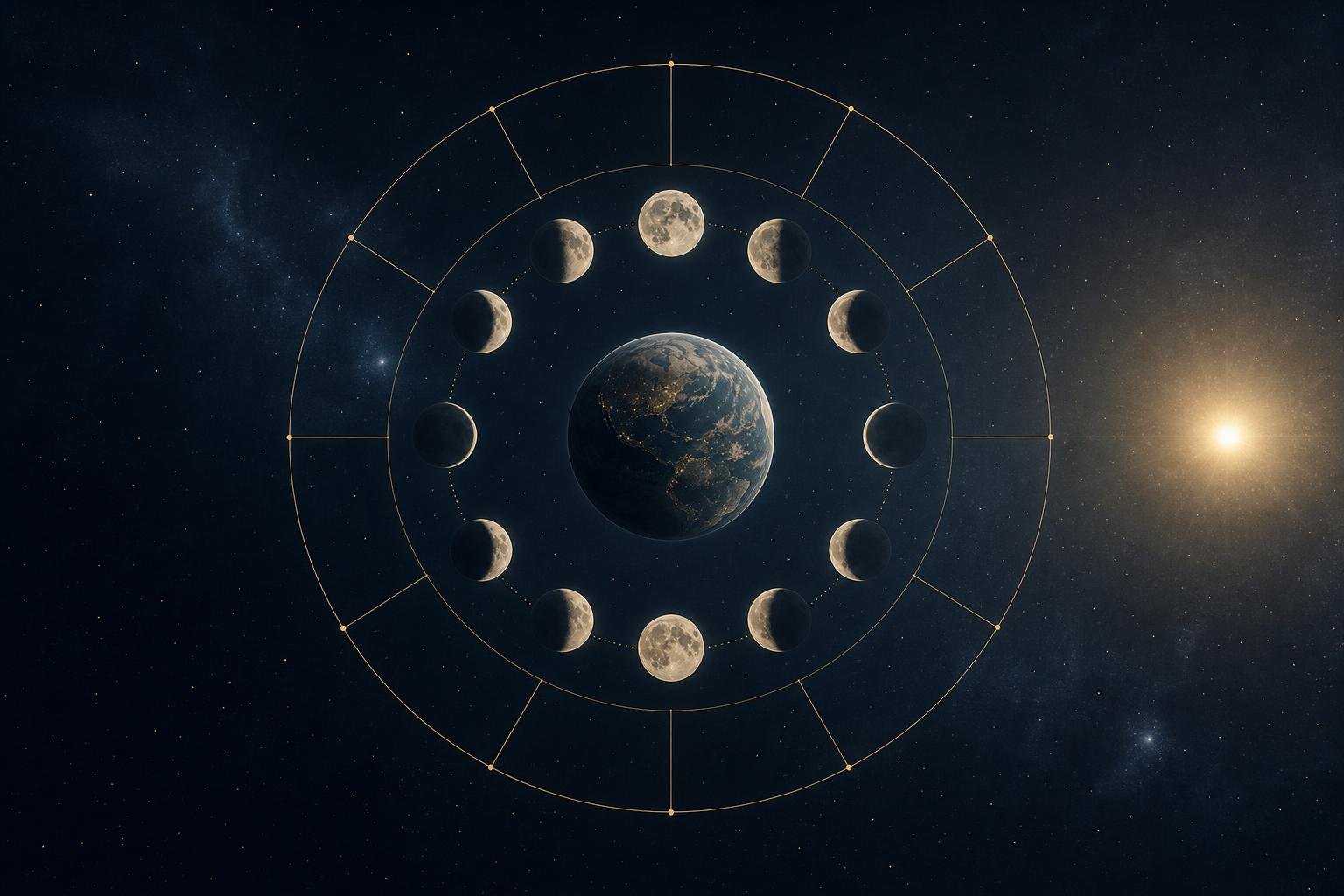
The Moon does not physically change shape over the course of a month. What changes is our view of the half illuminated by the Sun. This familiar cycle gives us crescents, quarter moons and the bright disc of a full moon—but the exact astronomical definitions are more precise than everyday phrases such as “full-moon energy” might suggest.
The full moon on 26 September 2026 provides a useful example. It is a calculable moment in the relationship between the Sun and Moon, while the label “in Aries” belongs to astrology’s symbolic framework. Those two descriptions can sit alongside each other, but they do not mean the same thing.
New and full moons are exact moments
At any given time, one half of the Moon is illuminated by the Sun. As the Moon travels around Earth, we see different proportions of that illuminated hemisphere. The phases describe this changing view.
Astronomers define the principal phases using the apparent ecliptic longitudes of the Sun and Moon as observed from Earth. At a new moon, their angular difference is 0 degrees. At a full moon, it is 180 degrees. In other words, the Sun and Moon appear on opposite sides of the sky at the precise moment of full moon.
This is why a new moon or full moon is technically an instant rather than a period lasting several days. The Moon can look almost completely full on the nights immediately before and after that instant, so ordinary speech is understandably less exact. But when a calendar gives a specific time for a full moon, it refers to the calculated moment of angular opposition.
At new moon, the predominantly unilluminated side faces Earth, making the Moon difficult or impossible to see under normal circumstances. At full moon, its illuminated side faces us. This change in appearance follows from geometry and sunlight; Earth’s shadow is not what ordinarily creates the phases.
Why every full moon is not a lunar eclipse
If a full moon places the Sun and Moon opposite each other, why does Earth’s shadow not cover the Moon every month? The answer lies in the tilt of the Moon’s orbit.
The Moon’s orbital plane is inclined by roughly five degrees to the plane of Earth’s orbit around the Sun. As a result, the Moon usually passes a little above or below the alignment required for an eclipse. Its orbit crosses the relevant plane at two points known as lunar nodes.
An eclipse requires a new or full moon to occur sufficiently close to one of those nodes. Near a new moon, the right alignment can produce a solar eclipse. Near a full moon, the Moon can pass through Earth’s shadow and produce a lunar eclipse.
A lunation alone is therefore not enough. Phase tells us the angular relationship between the Sun and Moon; an eclipse also depends on how close the Moon is to a node. The full moon of 26 September 2026 will not be a lunar eclipse.
What happens on 26 September 2026
The exact full moon will occur on September 26, 2026, 17:49 (London). At that moment, the apparent ecliptic longitudes of the Sun and Moon will differ by 180 degrees from an Earth-based viewpoint.
That wording matters. A regular full moon does not require the centres of the Sun, Earth and Moon to form a perfectly straight three-dimensional line. If the Moon were also positioned sufficiently close to a lunar node, the geometry could instead produce a lunar eclipse.
For casual observation, there is no need to treat 17:49 as the only worthwhile minute. The Moon will appear broadly full around the event. The precision belongs to the astronomical definition, not to a sudden visual switch in the sky.
A phase is not a zodiac sign
“Full moon” and “Moon in Aries” answer different questions.
The phase describes the angular relationship between the Sun and Moon. A zodiac sign, in astrological practice, identifies the section of the ecliptic assigned to a celestial body’s position. The astrological zodiac divides the ecliptic into twelve equal sections of 30 degrees each.
These signs should not be confused with astronomical constellations. Constellations are mapped regions of the sky with unequal sizes and formally defined boundaries. Astrological signs are equal divisions within a zodiacal coordinate framework. The two systems use many of the same names, but they are not interchangeable maps.
It also follows that the Moon’s phase cannot reveal its sign. A full moon can occur in any zodiac sign, depending on where the Sun–Moon opposition falls along the ecliptic. To know both the phase and the astrological sign, both positions must be calculated.
What “full moon in Aries” adds
In the astrological framework used for this event, the Moon is placed in Aries. The phrase “full moon in Aries” therefore combines two layers: a measurable lunar phase and an astrological sign assignment.
Astrological tradition then adds a symbolic vocabulary. Aries is commonly associated with initiative, directness and independent action. Read in that spirit, this full moon might serve as a prompt to consider where quick action is useful, where bluntness needs restraint, or where acting alone has become less effective than asking for cooperation.
These are reflective associations, not a scientifically demonstrated mechanism by which the Moon causes personal events. They are most useful as open questions rather than predictions. The same symbol may lead different readers to very different observations about their circumstances.
Three questions for reading lunar interpretations critically
When a headline makes a dramatic claim about a new moon, full moon or eclipse, three questions can quickly clarify what is being said:
- Is this an astronomical fact or a symbolic interpretation? A phase and its exact time can be calculated. Claims about its personal meaning belong to interpretation.
- Is the text discussing a phase, a sign or an eclipse? These terms describe distinct things and should not be used as synonyms.
- Does a general association become a certain cause or prediction? A symbolic theme can prompt reflection without being presented as an inevitable external influence.
The distinction does not require choosing between observing the sky and engaging with astrological culture. It simply keeps the categories clear: the full moon is a precise geometrical event, an eclipse requires additional alignment near a lunar node, and “in Aries” introduces a separate interpretive language.