The September equinox is both a precisely measurable moment and one of the seasonal anchors of the tropical zodiac. Astronomy describes the Sun crossing the celestial equator; tropical astrology calls the same point the beginning of Libra.
This overlap is built into the structure of the tropical zodiac. Its signs are aligned with the equinoxes and solstices, which is why the arrival of astronomical autumn in the Northern Hemisphere coincides with the Sun’s entry into Libra. The familiar themes of balance and proportion developed from that seasonal framework.
The current turning point in the sky
The Sun enters Libra on September 23, 2026, 01:05 (London). At that moment, its apparent ecliptic longitude reaches 180 degrees.
Ecliptic longitude describes a position along the ecliptic, the path the Sun appears to follow across the sky during the year. The measurement begins at zero degrees at the March equinox. The September equinox lies halfway around the circle, at 180 degrees.
The phrase “the Sun enters Libra” can sound as though the Sun is crossing a physical boundary in the sky. In the tropical system, however, Libra is one of twelve equal sections measured from the March equinox. Reaching 180 degrees therefore means reaching the opening degree of Libra.
This coordinate also marks a change of season. In the Northern Hemisphere, it is the beginning of astronomical autumn. In the Southern Hemisphere, it is the beginning of astronomical spring.
What astronomers mean by the September equinox
Astronomically, the September equinox is the instant when the centre of the Sun, in its apparent movement, crosses the celestial equator heading south.
The celestial equator is Earth’s equator projected onto the imaginary sphere of the sky. Because Earth’s rotational axis is tilted relative to its orbit, the Sun appears north of this line during one part of the year and south of it during another. It crosses the line twice: northward at the March equinox and southward at the September equinox.
Although “equinox” evokes the idea of equal night, the date does not bring exactly twelve hours of daylight and twelve hours of darkness to every location. Several practical details complicate the picture. Sunrise and sunset are normally timed using the upper edge of the solar disc rather than its centre. Atmospheric refraction also makes the Sun appear above the horizon when it is geometrically just below it. Latitude and local observing conditions introduce further variation.
The equinox itself is therefore a single calculable instant. The date on which daylight and darkness come closest to equality in a particular place can differ slightly from it.
How tropical astrology names the same point
The tropical zodiac uses the annual seasonal cycle as its framework. It places zero degrees of Aries at the March equinox and divides the ecliptic into twelve equal sections of 30 degrees each.
Six sections later comes the opposite point of the zodiac: zero degrees of Libra at the September equinox. In other words, the astronomical crossing and the tropical Sun’s entry into Libra are not two events happening side by side. They are two ways of describing the same position, each within a different system of language and classification.
This arrangement has deep roots in Western astrology. In the Tetrabiblos, Ptolemy identifies Aries and Libra with the two equinoctial points. Aries belongs to the March crossing and Libra to the September crossing. The association between Libra and the autumn equinox is therefore not a recent resemblance based only on the sign’s name or image; it is part of the zodiac’s long-established seasonal organisation.
The tropical zodiac remains tied to those seasonal markers. Its beginning is defined by the March equinox rather than by the present-day positions of similarly named constellations. That is why its zero point of Libra continues to coincide with the September equinox.
Why the scales became an image of balance
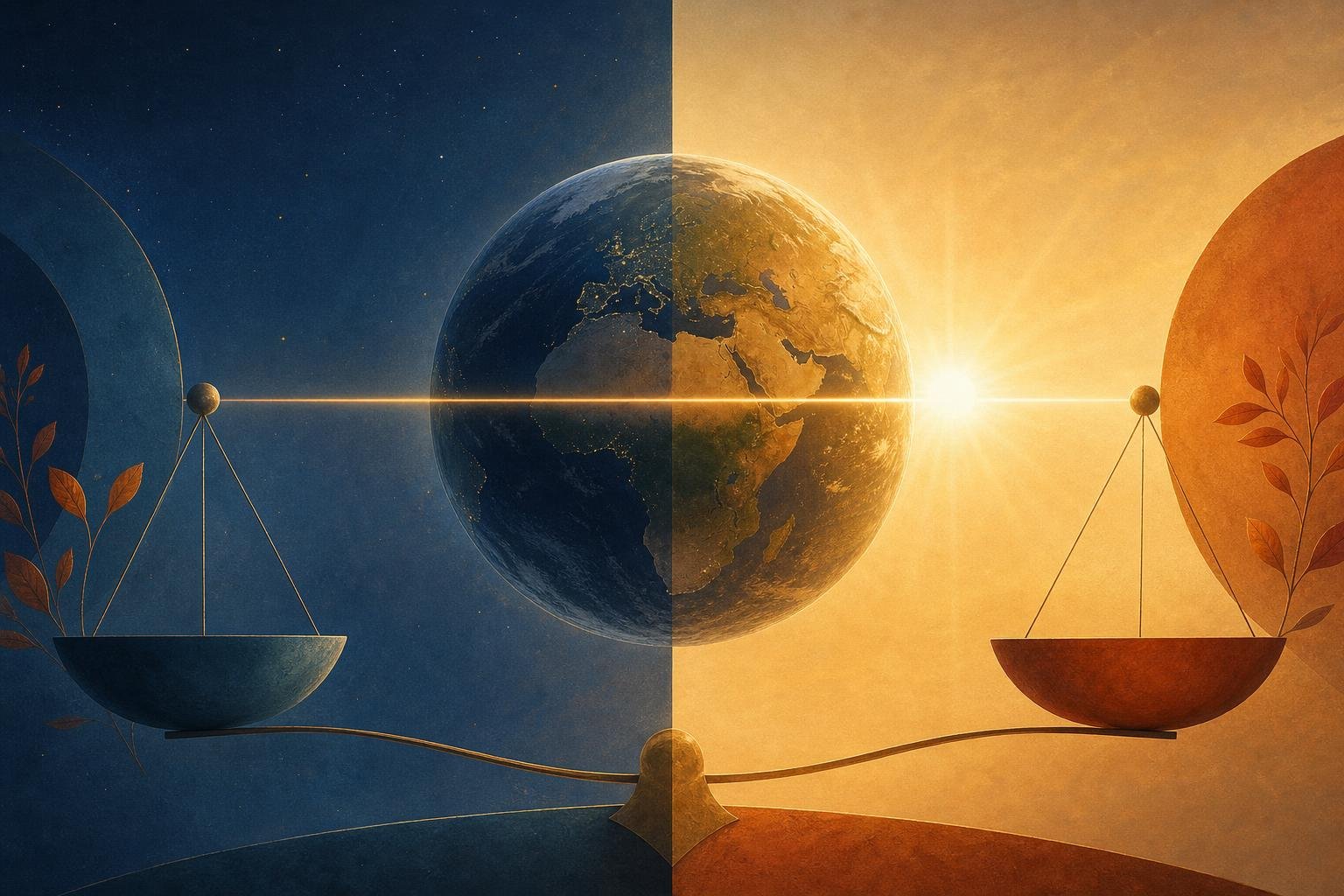
Libra’s scales offer a particularly clear metaphor for an equinoctial point. Two sides are placed in relation to one another, their proportions become visible, and any imbalance calls for adjustment. Around the September equinox, the yearly cycle passes through a point traditionally described through the changing relationship between light and darkness.
Yet scales do not suggest permanent stillness. Their pans respond to every change in weight. Balance is produced through comparison and repeated correction, not by freezing both sides in a flawless arrangement.
Seen this way, Libra’s symbolism is broader than the instruction to keep everything equal. It can represent weighing competing considerations, testing whether an exchange is proportionate and looking for an arrangement that acknowledges more than one position. This is how the tradition arrives at related ideas such as reciprocity, negotiation, fairness and agreement.
Nor does balance necessarily mean splitting everything down the middle. Scales are instruments of judgement: they reveal when two sides differ and help establish how much adjustment is required. A balanced result may involve recognising that two claims do not carry the same weight.
That distinction also clarifies the status of the symbolism. The equinox is a measurable astronomical moment, while the themes of agreement, proportion and adjustment belong to astrology’s cultural and interpretive tradition. They are not scientifically established causes of human behaviour or promises of particular events.
The lasting power of the image lies instead in its precision as a metaphor. At a point defined by opposition across the zodiac and by a seasonal crossing in the sky, the scales turn balance into an active process: compare, assess, correct and compare again.
Sources
- Earth’s Seasons – Equinoxes, Solstices, Perihelion, and Aphelion
- US Naval Observatory: Glossary
- US Naval Observatory: Length of Day and Night at the Equinoxes
- NASA: Embracing the Equinox
- Ptolemy, Tetrabiblos, Book I, §§ 4–24
Astrological overview of the period
| Date and time (London) | Event | Body | Sign |
|---|---|---|---|
| September 23, 2026, 01:05 | sign ingress | Sun | Libra |
| September 24, 2026, 04:23 | sign ingress | Moon | Pisces |
| September 26, 2026, 11:23 | sign ingress | Moon | Aries |
| September 26, 2026, 17:49 | full moon | Moon | Aries |
| September 28, 2026, 03:48 | sign ingress | Mars | Leo |
| September 28, 2026, 15:40 | sign ingress | Moon | Taurus |