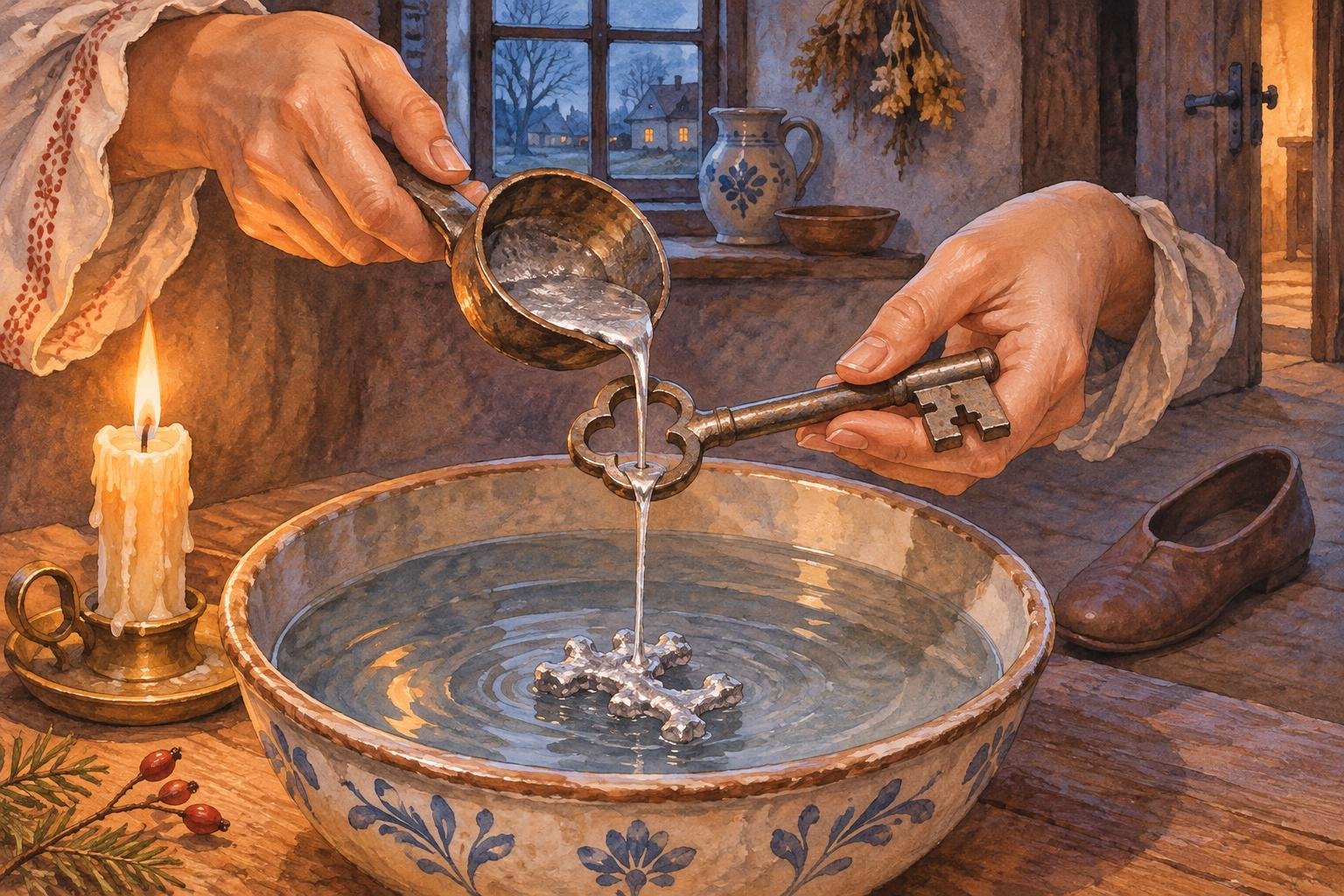
A thin stream of molten lead runs through the eye of a cross-shaped key and hisses into a bowl of cold water. In an old farmhouse room, this was no decorative winter scene. It was a question put to the future: what would the man a girl might marry look like, and what kind of life would he bring?
On St Andrew’s Eve, the night of 29 to 30 November, girls in Central Europe read such signs with impressive directness. The lead had to yield a shape, the shoe had to point somewhere, and a dog’s bark had to come from a particular direction. The subject was marriage, and the household became a small theatre of clues.
It was divination, certainly. But it was not a horoscope. St Andrew’s Eve found its answers in a room, a yard and the dark beyond the fence. A horoscope reads the ordered arrangement of the sky.
Lead through the key gave the groom an outline
The lead was poured into cold water, sometimes through the eye of a cross-shaped key. The hardened lump was turned in the hand, held to the light and interpreted. A shape might suggest the future husband’s looks or trade. It did not need to resemble anything perfectly. A hint was enough.
A boat could signal a long journey. A heart spoke plainly of love. A ring needed no committee meeting: it meant marriage. The lead offered an image, and the onlookers supplied the story.
That is the charm of it. A formless bit of metal became a sailor, a craftsman or a bridegroom because the room was ready to see him there. And the key added a neat piece of domestic drama: the future passed through an object made to open doors.
The shoe settled who would leave home
Then came the shoe. A girl threw it over her shoulder towards the door. If the toe landed pointing outward, it was a favourable sign: she would leave home within the year, traditionally to marry.
This was blunt forecasting by footwear. No pattern to decode, no waiting for a distant sound. The door was the whole point. A shoe facing it gave the answer everyone wanted; a shoe turned back into the room was a duller verdict.
The custom says something concrete about older village life. Marriage meant more than romance. It meant departure, a new household and a new place in the world. The shoe made that threshold visible on the floorboards.
The fence and the dog supplied a direction
A third scene took the girl outdoors at night. She shook a fence or a tree and listened. From which side did a dog bark? That was the direction from which the groom was expected to come.
The dog was not there for atmosphere. Its bark served as a compass point.
There is something wonderfully exact about it. Lead gave a silhouette and the shoe judged the chances of leaving home, but the barking dog was asked for geography. The imagined husband had no name yet, but he already had a direction of travel.
Other customs filled the same night: knocking at a henhouse, counting splinters, listening for noises. They worked on one principle. An ordinary object or sound, met at the right moment, became charged with an answer.
In 2026, the night opens Advent
St Andrew’s Day falls on 30 November. In 2026 the first Sunday of Advent is 29 November, so the night sits right at Advent’s opening. For Scots, the date has another weight: 30 November is their national day, and the flag is the saint’s white saltire cross.
The timing suits the old mood: late autumn, early darkness, a household gathered indoors and a future imagined just beyond the door. Andrew was regarded as a patron of brides, and the surviving customs of the night carry a distinctly marital theme.
The calendar gave the rite its stage. The answers came from whatever the household could arrange: a key, a bowl, a shoe, a fence and a dog somewhere in the dark.
A horoscope reads the sky, not the shoe
The old customs and astrology meet at one point: both take timing and signs seriously. Yet they do not read the same material.
St Andrew’s Eve looked for an immediate sign in the domestic or village world. The lead’s accidental outline, the shoe’s position and the direction of a bark became messages because they appeared on a special night. The answer was quick, local and tangible.
A horoscope works from the ordered configuration of the sky. In the classical tradition described by Ptolemy, the reader weighs the movements and positions of the Sun, Moon and planets, and the angles they form with one another. A planet entering a sign or an exact aspect is a different kind of signal from a shoe landing toe-first by a door.
The lead had better theatre. But the heavens had their own grammar.
Sources
This article has been editorially reviewed
This article has been checked for factual accuracy, language quality and compliance with editorial standards.
 Victor, Virtual astrologer