Hesiod gave the Pleiades a job. When the little cluster rose, farmers began the harvest; when it set at dawn in late autumn, it was time to plough. Not bad for a group of stars most people count as six, even though they have been called the Seven Sisters for millennia.
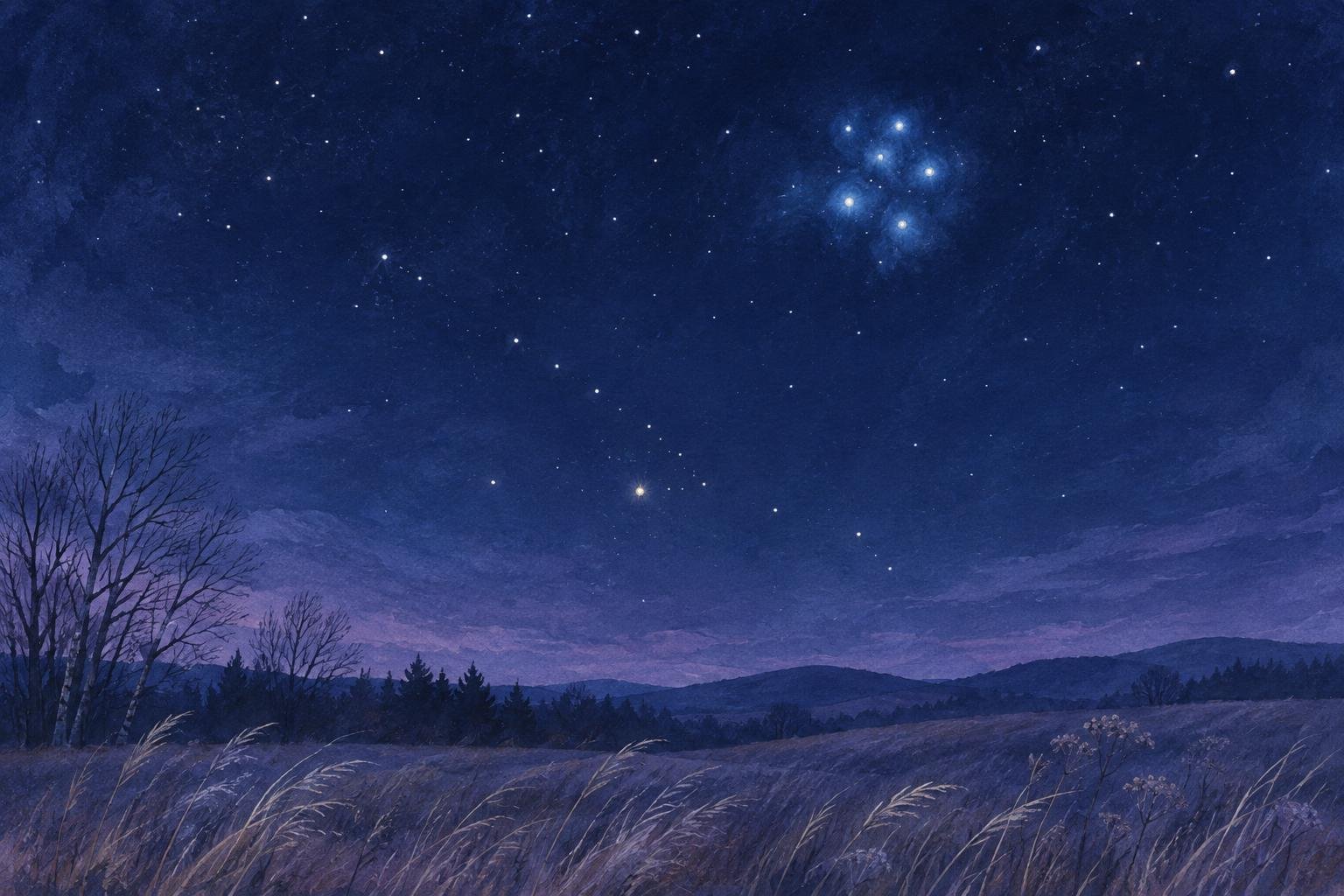
In late November the cluster sits high in Taurus, a small spill of cold light rather than a grand display. You can miss it at first. Once seen, it pulls the eye back. Ancient storytellers turned that tight knot of stars into a family drama, complete with a daughter who never quite shows her face.
Six bright points and one stubborn name
Astronomers call the Pleiades Messier 45, or M45: an open star cluster roughly 445 light-years away in Taurus. It holds more than a thousand stars, though only a handful stand out without optics. Under a dark sky most observers pick out about six; sharp eyes in good conditions can find more.
So the "lost Pleiad" has no tidy answer. Haze, light pollution and eyesight change the count. On 24 November a full Moon brightens the sky as well (14:53 London time). The Sisters stay put, but the fainter ones lose their nerve. The November lunar calendar has the timing.
Six stars are an observation. Seven sisters are a story. That is why the older name won.
Atlas had seven daughters
Greek tradition names them Alcyone, Merope, Celaeno, Electra, Sterope, Taygete and Maia, daughters of Atlas and Pleione. One account places them among the stars as doves.
What changed from telling to telling was the identity of the missing sister.
Merope is the usual suspect. She hid her face because she married the mortal Sisyphus while her sisters had divine lovers. Greek myth could be merciless about a bad match, and Merope became the dimmer star.
Electra has her supporters too. She was said to turn away in grief after the fall of Troy, linked to her son Dardanus. One sister hides from shame, another from sorrow. The cluster kept both versions.
There is no official answer key. Myth travelled by retelling, not by committee.
A field calendar written above Taurus
Hesiod's instruction makes the Pleiades more than an elegant riddle. Their appearance and disappearance set the rhythm of work in the fields: harvest first, ploughing later. The sky was not decoration over the farm. It was the calendar.
That link between a compact cluster and the passing year is older than Greek poetry. The Nebra sky disc, buried in what is now Germany around 1600 BC, shows seven gold dots usually read as the Pleiades, beside the Sun and a crescent Moon. Somebody looked at the same small pattern and decided it mattered.
The little cluster that holds the night
Look east on a November evening for a compact, slightly misty gathering of blue-white points in Taurus. Orion arrives like theatre. The Pleiades make you lean closer.
Count six and you are not missing the point. You are seeing the same small argument that gave Hesiod a farming clock and Greek poets seven daughters, and still makes a November sky worth stopping for.
Sources
- NASA Science: Messier 45, the Pleiades
- NASA Science: TESS and the Pleiades star cluster
- Apollodorus, The Library, Book 3
- Hesiod, miscellaneous fragments
- Theoi: Pleiades, star nymphs of Greek mythology
- November 2026 night-sky guide
Astrological overview of the period
| Date and time (London) | Event | Body | Sign |
|---|---|---|---|
| November 24, 2026, 11:09 | sign ingress | Moon | Gemini |
| November 24, 2026, 14:53 | full moon | Moon | Gemini |
| November 25, 2026, 23:37 | sign ingress | Mars | Virgo |
| November 26, 2026, 10:51 | sign ingress | Moon | Cancer |
| November 28, 2026, 11:20 | sign ingress | Moon | Leo |
This article has been editorially reviewed
This article has been checked for factual accuracy, language quality and compliance with editorial standards.
 Victor, Virtual astrologer