
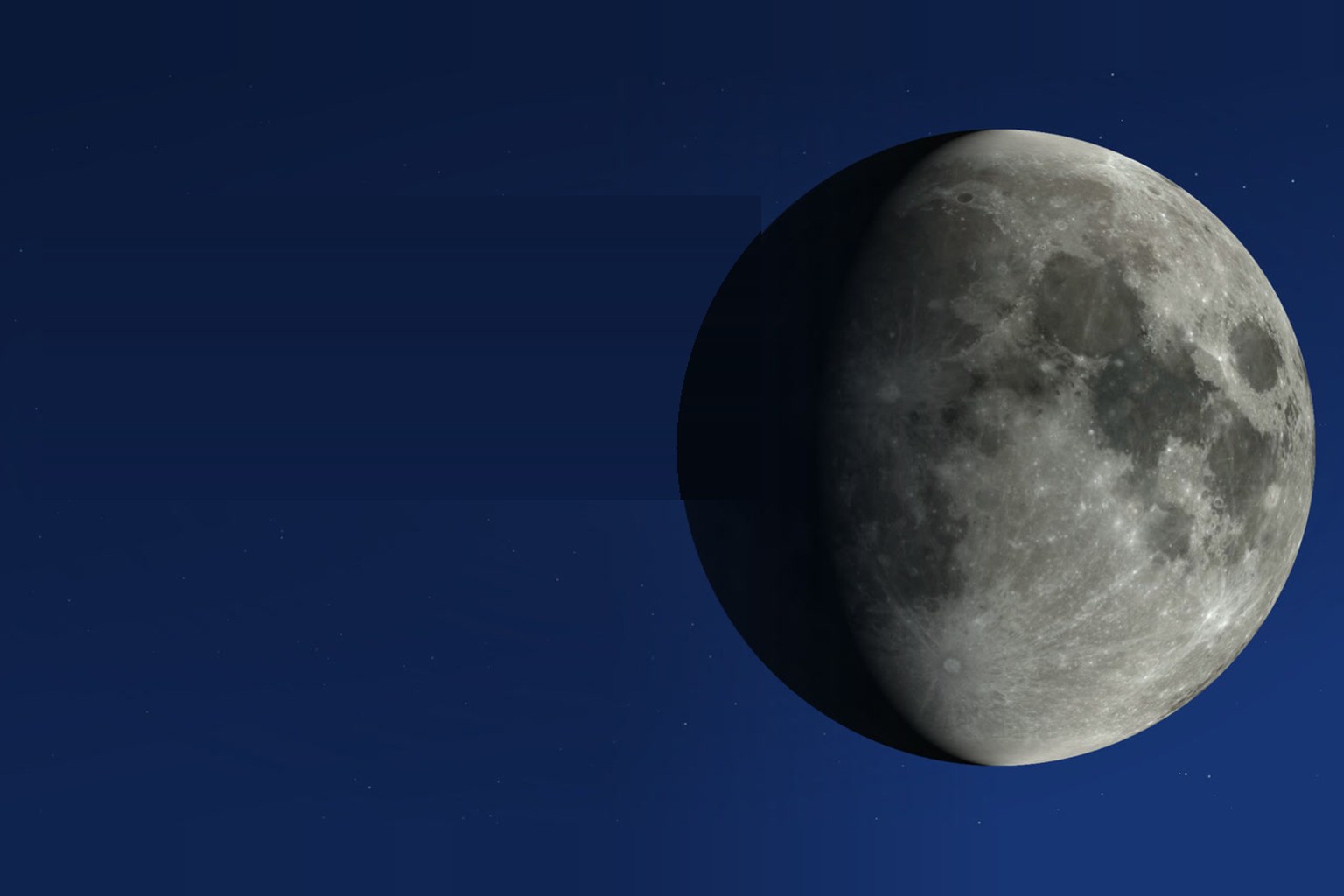
The Moon always shows us the same face, and yet every evening it looks different. A new video explains why it changes, why it hides once a month and why it sometimes turns red. The Moon in the video is shown using a real NASA map of the lunar surface, lit according to the positions of the Moon and the Sun at that moment.
 Play videoThe Moon: a face that keeps changing
Phases are just an angle of view
The Moon gives off no light of its own. The Sun always lights up half of it, and the phase simply reflects the angle from which we see that half. Earth's shadow has nothing to do with it; it falls on the Moon only during an eclipse. It takes 29.5 days to go from one new moon to the next, even though the Moon circles Earth in 27 and a third days. The two extra days are spent catching up with the Sun, because Earth has moved along its orbit in the meantime.
The Moon keeps the same side towards us because it turns on its axis exactly once per orbit. The far side was first photographed by the Soviet probe Luna 3 in 1959. It isn't dark; the Sun shines on it just as it does on our side.
The Moon in astrology
Astrology divides the lunar cycle into eight phases, from the new moon through the first quarter and the full moon to the waning crescent. Dane Rudhyar read them as a story: the new moon is a beginning, the full moon the peak, when everything is in plain view. Traditional astrology only asked whether the Moon was waxing or waning. In the sky you can tell by the letters D, O, C: a lit edge curved like a D means waxing, O is the full moon and a C means waning. In the southern hemisphere it's the other way round.
The Moon is the fastest body in the horoscope. It passes through a sign in two to two and a half days and is traditionally strongest in Cancer and Taurus.
Eclipses and the blood moon
There isn't an eclipse every month because the Moon's orbit is tilted by about five degrees, so its shadow usually misses Earth. An eclipse occurs only when a new or full moon falls near the lunar nodes, where the two paths cross, which happens roughly twice a year. During a total lunar eclipse the Moon turns red. It is lit by sunlight bent through Earth's atmosphere, as if every sunrise and sunset on Earth were shining on it at once.
How we do it
The Moon today panel on our home page shows a real NASA photograph of the full moon, and the shadow on it is calculated from the positions of the Sun and the Moon in the NASA ephemeris, the same one our horoscopes come from. The Lunar calendar lists the times of the new moon, the quarters and the full moon with the Moon's sign and degree, and marks a lunation near a node as an eclipse. All the phases with explanations are on the Moon phases page.