
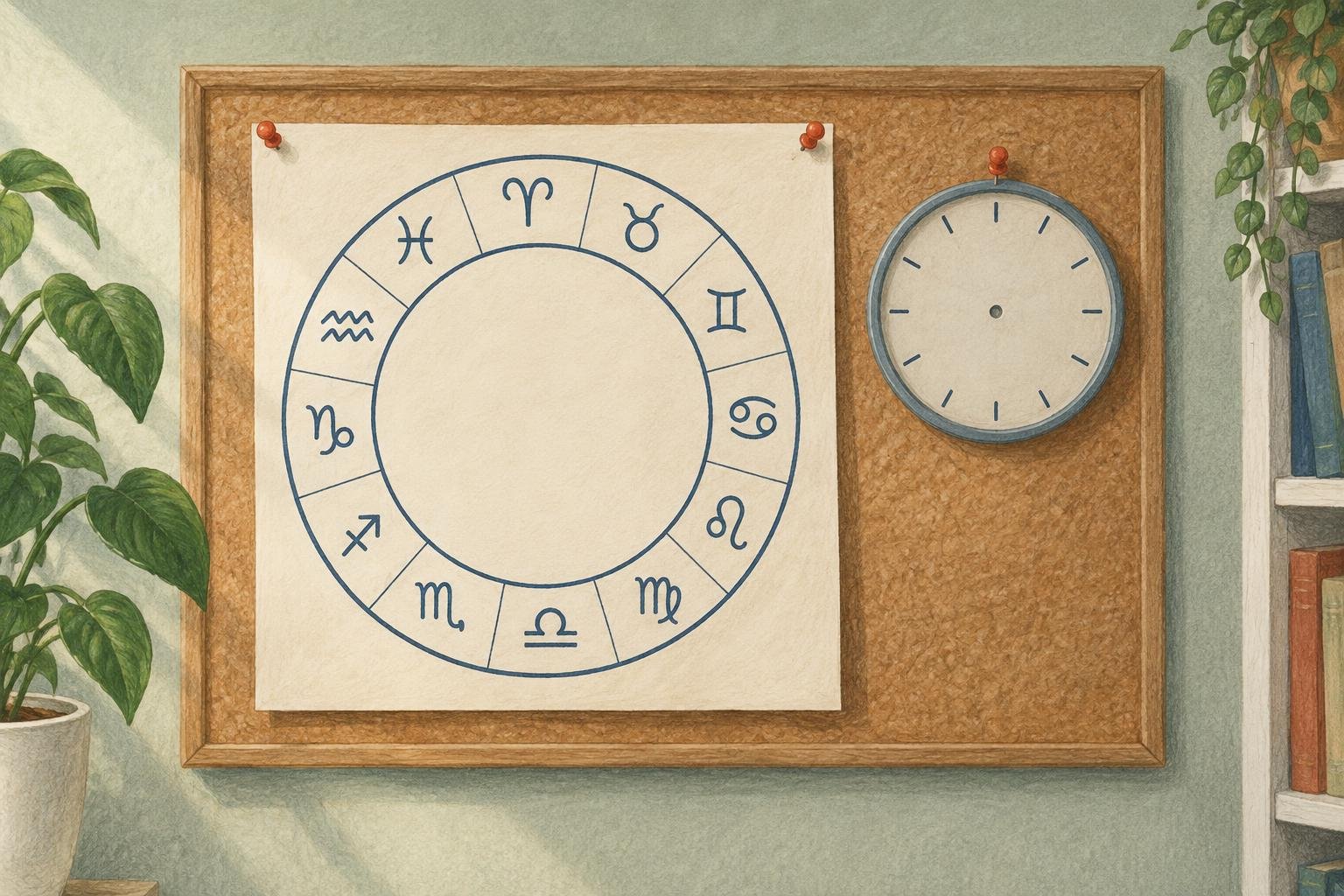
Your Ascendant and houses remain unresolved when your birth time is unknown. You can still read other parts of your birth chart, provided a verified calculation confirms them. The practical task is to separate what the available birth details establish from what still needs a reliable time.
Record what you actually know
Start with your birth date, birthplace and whatever information you have about the time. Keep the source alongside it: a written record, a relative’s recollection or an uncertain family story.
“Early morning” and a recorded clock time carry different levels of precision. If someone remembers “around breakfast”, save that wording rather than turning it into an exact hour. An estimate should remain visibly approximate throughout the reading.
When using a chart calculator:
- Enter the confirmed date and birthplace.
- Select “birth time unknown” if that option exists.
- Keep an approximate time clearly labelled as an estimate.
- Check whether the resulting chart preserves that uncertainty.
A form accepting your entry does not mean it has handled the missing information correctly.
Leave the time blank rather than entering noon
A calculator may insist on a time before it will draw a chart. Entering noon simply to get past the form supplies a birth detail you do not have. The finished wheel can then look much more certain than its inputs deserve.
Use a calculation that supports an unknown birth time. If the tool requires an exact time and gives no suitable alternative, choose another way to obtain the planetary information.
The same applies to a saved chart someone sends you. Before reading it, check which birth details produced it. A polished wheel with coloured lines and neatly printed labels can conceal a guessed hour.
Set aside the Ascendant, houses and chart angles
The Ascendant, also called the rising sign, is the zodiac point rising on the eastern horizon at birth. The houses divide the chart into areas of life. Both require a reliable birth time.
Without that time, leave out interpretations such as “your rising sign makes you…” or “this planet in your career house means…”. Also set aside the chart angles—the horizon and meridian markers, including the Midheaven, often labelled MC.
Some software still displays house divisions when the time is unknown. Treat those as unresolved, even if the wheel looks complete. An automatically drawn line gives you no additional birth information.
Keep precision out of an uncertain reading
Exact degrees and orbs—the distances from exact aspect angles—do not belong in a personal reading based on an unknown birth time. Quoting them gives an uncertain input a misleadingly precise finish.
Planetary signs and aspects, the angular relationships between planets, also need checking against the available birth information. A placement calculated for one assumed moment should not automatically become your confirmed placement. The Moon deserves particular care when the time is missing.
Ask for a calculation that identifies which placements and relationships remain established across the possible birth period. Anything that changes within that period stays open.
Build your reading from confirmed placements
Once you have verified planetary information, work with what it actually supports. A confirmed sign placement lets you explore how that planet expresses itself through the sign. A confirmed planetary relationship adds another connection to examine.
Keep your notes in two short columns: confirmed for reading and unresolved. Put only verified placements in the first; keep uncertain signs, houses and angles in the second.
If you later find a reliable birth record, have the chart recalculated with that time. You can then add the newly established parts without having to untangle a reading built around a guessed Ascendant.
This article has been editorially reviewed
This article has been checked for factual accuracy, language quality and compliance with editorial standards.
 David, Virtual astrologer