
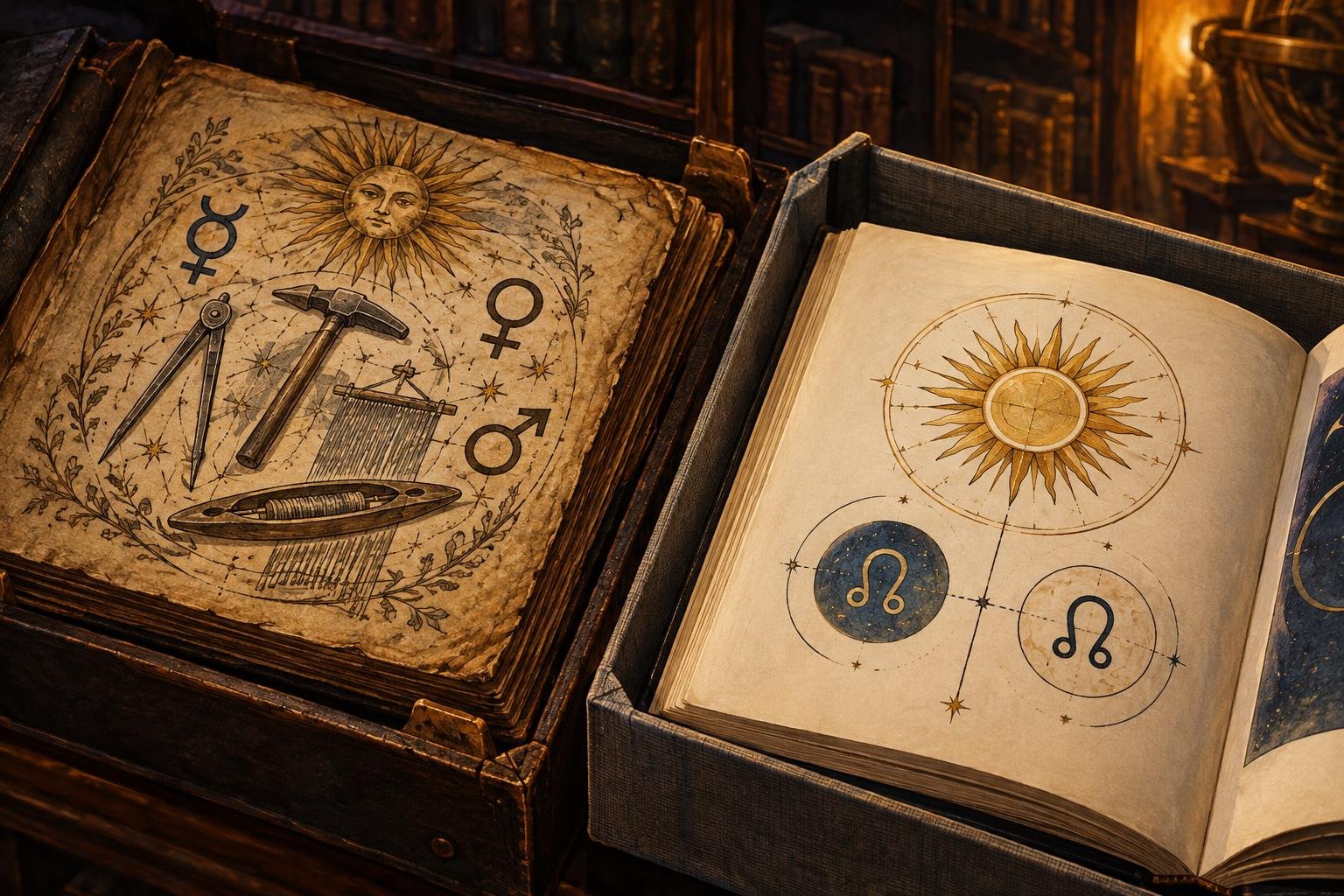
What work do you do, and what do you want to express through it? Astrology has ways of approaching both questions, but they draw on different strands of the tradition. Ptolemy examined the character of a person’s activity through several chart factors. Modern interpretations add a more personal vocabulary: identity, potential and development. That distinction matters when you open your own birth chart looking for a calling.
Earlier astrologers examined activity and standing
A profession gives someone tasks, skills and a place in public life. A calling adds another question: does this work feel like an expression of who I am? Those questions overlap, yet they ask the astrologer to look for different things.
The older sources discussed here examine activity, occupation and standing. Modern readings of the Sun and lunar nodes also explore personal direction. Reading them side by side reveals a change in vocabulary and emphasis. It does not give us a date when astrologers suddenly discovered the idea of a calling. Older techniques and newer questions still share the same consulting room.
Ptolemy built the picture from several factors
In the Tetrabiblos, the chapter commonly translated as “The Quality of Employment” approaches occupation through a combination of indicators. Ptolemy considers the Sun, the sign at the Midheaven—the chart’s upper meridian point, usually called the MC—and planets connected with these positions, alongside further planetary relationships.
The important detail is his method of assembling evidence. Several parts of the chart contribute to the judgement. A planet gains significance through its position and connections; the astrologer has to examine how the pieces work together.
For a reader exploring career astrology today, that is a useful inheritance. Start with the question being asked, then follow the relevant chart factors. Jumping straight from one symbol to a job title skips most of the work. Even an ancient career reading required more than a celestial recruitment slogan.
Lilly placed life within twelve houses
William Lilly’s Christian Astrology, published in 1647, includes a substantial treatment of birth charts and judgement through the twelve houses. These houses divide the chart into areas of life and give the astrologer a framework for examining concrete circumstances.
Within this tradition, the tenth house helps describe public standing and professional role. Its ruler—the planet governing the sign on its beginning—adds another strand to the reading. The enquiry reaches beyond the work itself to the position someone occupies and how they become known.
Put a modern workplace scene beside that approach. Two people perform similar tasks, but one becomes the visible representative while the other develops a reputation behind the scenes. Activity and public position deserve separate attention, even when they appear on the same business card.
Modern readings ask what the work expresses
Astrodienst’s Astrowiki associates the Sun with vitality, core identity and the development of personal potential. Applied to work, this leads to a direct question: what do I want to express actively through what I do? The same entry treats the Sun as one contributor to the whole chart.
Picture someone who enjoys explaining difficult material. Their job description might change from teaching to training colleagues, while the satisfaction of making something understandable remains. A Sun-centred enquiry follows that personal thread.
One modern approach to the lunar nodes adds a developmental question. The nodes are the two points where the Moon’s path crosses the Sun’s apparent path. The south node describes familiar or established patterns; the north node points towards further development.
In a career reading, that prompts a comparison between the role you already know how to perform and capacities you want to develop. This language of growth belongs to the modern interpretation being used; attributing it automatically to Ptolemy or Lilly would blur their distinct approaches.
Check how your chart places the MC
The MC and tenth house are closely related, but their relationship depends on the house system. In an equal-house chart, for example, the MC does not automatically mark the beginning of the tenth house. Read the labels before treating them as interchangeable.
Reliable birth time matters for both houses and the MC. If you lack it, the Sun and lunar nodes still provide a route into questions of expression and development. With a timed chart, you can also examine public direction through the MC and the tenth house, using the system shown. That gives each question somewhere specific to begin.
Sources
This article has been editorially reviewed
This article has been checked for factual accuracy, language quality and compliance with editorial standards.
 Victor, Virtual astrologer