
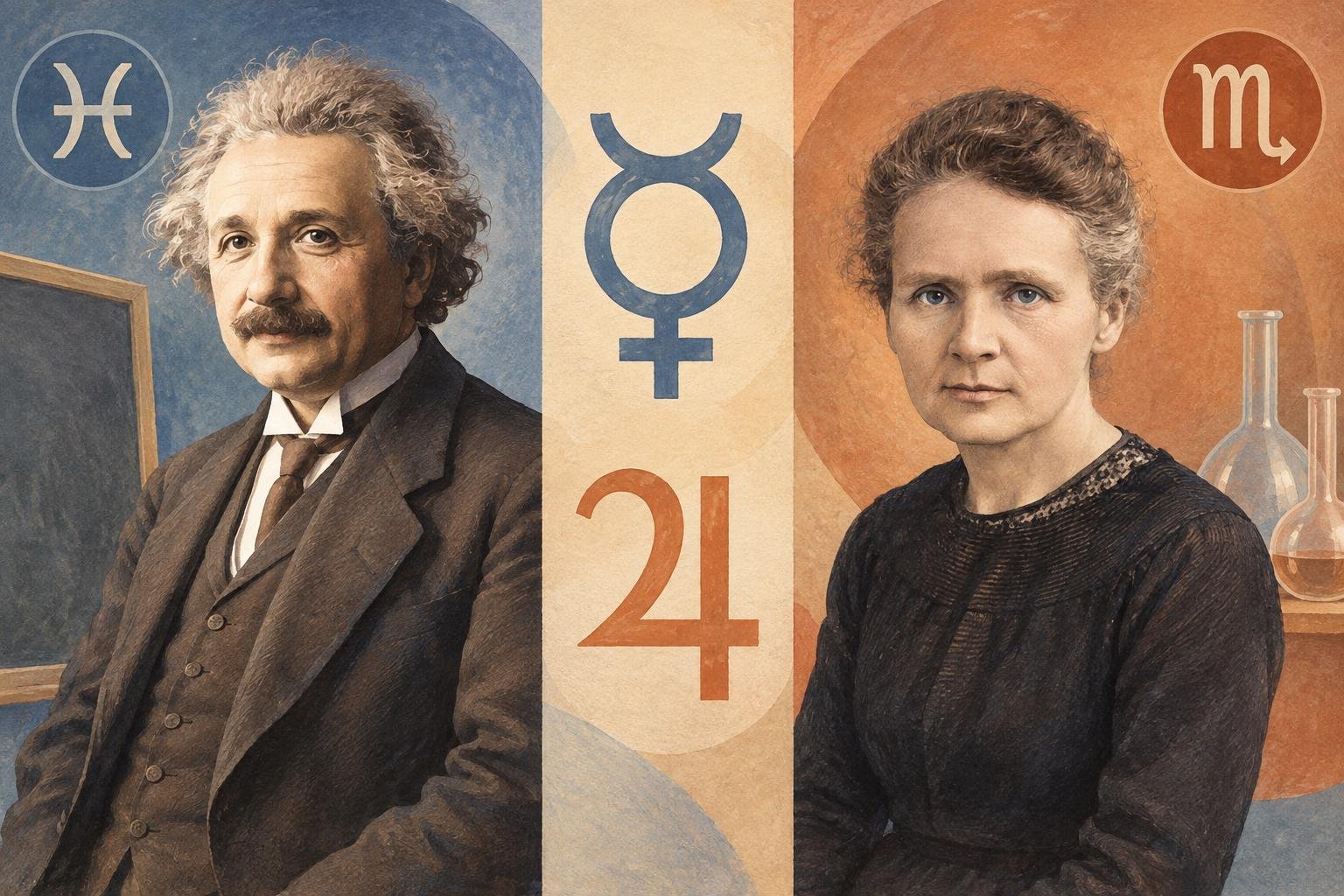
Albert Einstein and Marie Curie both had Jupiter in Aquarius. Follow that planet through their birth charts, however, and the resemblance takes two different directions. Einstein’s chart connects learning directly with his public career; Curie’s leads from Mercury through a sequence of planetary rulers to Mars in Scorpio. These two charts give us a practical lesson in joining the pieces of a horoscope.
Mercury handles the argument; Jupiter sees the bigger picture
In the astrological tradition represented by William Lilly’s Christian Astrology, Mercury governs reasoning, speech, writing and the handling of information. Jupiter belongs to learning, judgement and the search for a wider understanding. One assembles the argument; the other asks what it means.
The ninth house adds a setting: study, books, teachers, distant journeys and beliefs. A planet describes a function, its sign describes its manner, and its house identifies the part of life where it works. In traditional chart reading, the next step is to examine the planet’s connections and the ruler of its sign.
A sign ruler is the planet traditionally assigned responsibility for that sign. Mercury in Sagittarius, for example, directs us to Jupiter, Sagittarius’s ruler. We then look at Jupiter’s position and follow the next connection. Think of it as following a reference from one book to another.
Einstein’s Mercury puts a bold idea under scrutiny

Einstein’s Mercury stands in Aries in the tenth house of career and public standing. Traditional interpretation gives Mercury in Aries a direct, initiating style: start with a proposition and pursue it. The tenth-house placement brings that intellectual work into public view.
Then Saturn enters the room. Mercury forms a close conjunction with Saturn, meaning the two planets sit together in the chart. Traditional astrology associates this pairing with concentrated thought, careful construction and demanding standards. Aries presses ahead; Saturn asks whether the argument will hold.
That combination gives an astrologer a sharper description than “quick thinker”. It joins intellectual initiative with the labour of making an idea withstand scrutiny. Einstein’s documented work in theoretical physics provides the concrete setting, including his explanation of the photoelectric effect, specifically recognised in his Nobel Prize citation.
Jupiter links scholarship with public standing
Einstein’s Jupiter in Aquarius occupies the ninth house. In traditional interpretation, Jupiter’s search for understanding takes on Aquarius’s detached, independent approach. The ninth house places that search among study, teaching and far-reaching ideas.
There is another connection: Jupiter rules Pisces, the sign at the beginning of Einstein’s tenth house. The ruler of his public career therefore sits in the house of advanced learning. For a physicist and professor, that is a particularly clear connection between what he studies and what he becomes known for.
Curie’s Mercury leads all the way to Mars

Curie’s Mercury is in Sagittarius. In the traditional reading, this Mercury reaches towards broad explanations and the larger purpose of an inquiry. Following its ruler reveals how that search takes shape:
- Mercury in Sagittarius leads to Jupiter, because Jupiter rules Sagittarius.
- Jupiter in Aquarius leads to Saturn, the traditional ruler of Aquarius.
- Saturn in Scorpio leads to Mars, the traditional ruler of Scorpio.
- Mars in Scorpio ends the chain, because Mars occupies its own sign.
Traditional astrologers call that last planet the final dispositor: the chain of sign rulers comes to rest there. Here, Mercury’s search for understanding ultimately answers to a Mars that tradition associates with sustained effort, resolve and the ability to push through resistance.
Curie’s studies in physics and mathematics, her laboratory leadership and her research into radioactivity give this reading a specific working environment. The broad question passes through judgement and discipline before reaching persistent action at the laboratory bench.
Jupiter also forms squares—challenging planetary connections—with both Saturn and Mars. In traditional interpretation, those ties bring friction between expanding an investigation, accepting its limits and driving the work forward.
The shared Jupiter reaches two different destinations
Follow Einstein’s Jupiter through its traditional rulers and it reaches Saturn in Aries, then Mars in Capricorn. Saturn and Mars occupy each other’s signs, creating a continuing exchange between restraint and initiative. His Mercury enters that same exchange through Mars, ruler of Aries.
Curie’s chain has a firm endpoint: Mars in its own Scorpio. Her Mercury and Jupiter both lead there. Put the two routes side by side and the distinction becomes precise: Einstein’s chart keeps passing the work between Saturn and Mars; Curie’s gathers it under Mars’s command.
Sources
This article has been editorially reviewed
This article has been checked for factual accuracy, language quality and compliance with editorial standards.
 Victor, Virtual astrologer