Two names, two crossing points
The Dragon’s Head is the ascending lunar node, and the Dragon’s Tail is the descending lunar node. If you encounter these names while reading about a birth chart, they refer to two points associated with the Moon’s path—not to additional heavenly bodies.
Their unusual names belong to astrology’s historical vocabulary. To understand them, it helps to bring together three things: the geometry of the Moon’s motion, a medieval explanation of the dragon image, and surviving evidence of how astrologers classified the nodes.
In the fourth chapter of De sphaera, Sacrobosco identifies the head as the crossing where the Moon passes from the southern side of the ecliptic to the northern side. The tail is the opposite crossing, where it passes from north to south. Here, north and south describe the Moon’s position relative to the ecliptic, not its location above the Earth’s hemispheres.
The ecliptic is the Sun’s apparent yearly path against the stars. The Moon’s path is inclined to it, producing two opposite crossings. The direction of passage distinguishes the head from the tail: ascending means south to north; descending means north to south.
How Sacrobosco found a dragon in the circles
Why call these crossings a head and a tail at all?
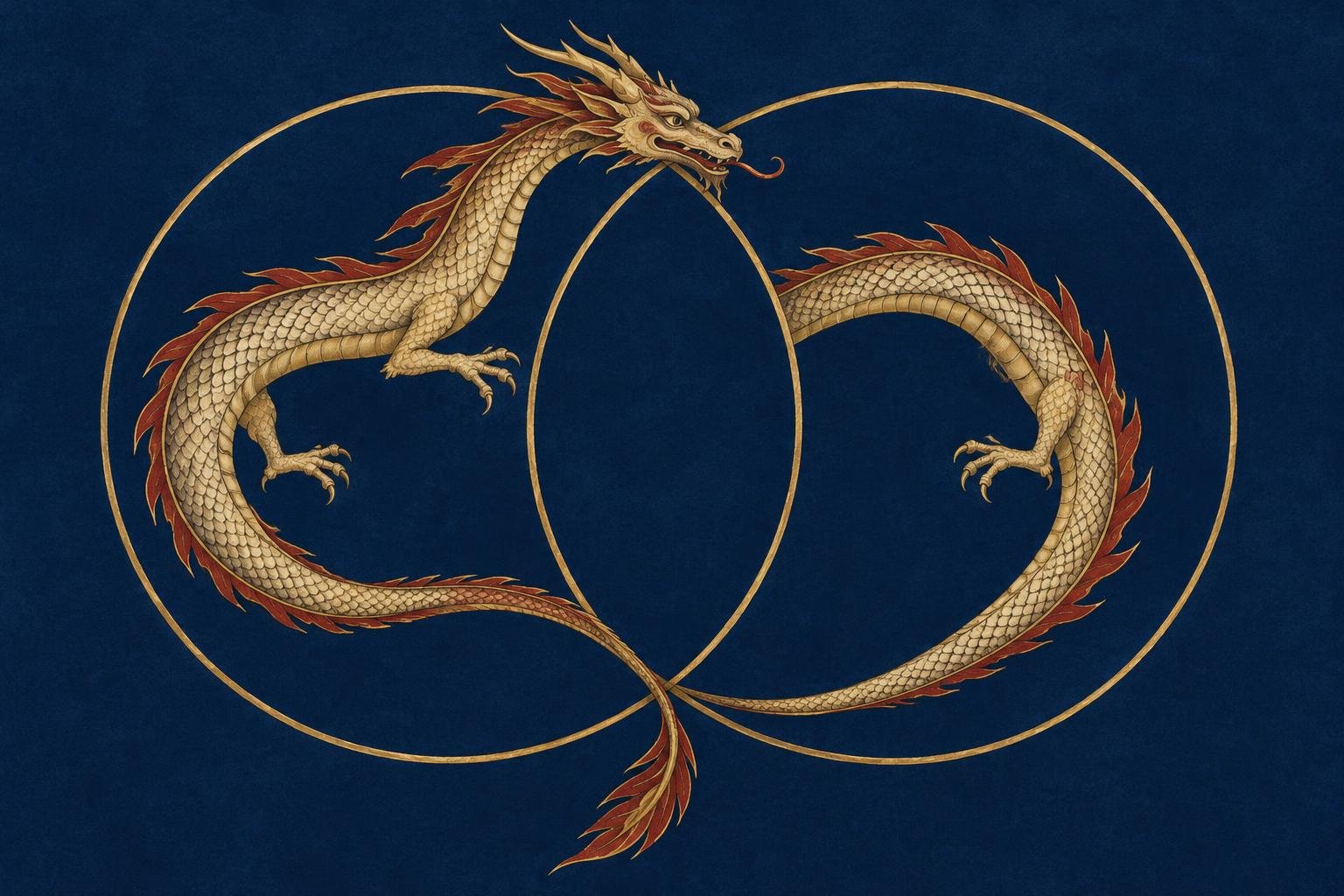
Sacrobosco offers a visual explanation. Within the intersecting circles of his account, he describes a figure that is broad in the middle and narrows towards its ends. That shape supplies the resemblance to a dragon, with the two crossings associated with its head and tail.
The explanation belongs within his medieval, Earth-centred model of the heavens. It should not be treated as a modern diagram of the Moon’s orbit with a decorative creature added. The circles and the shape they enclose are part of the way his account makes the heavens intelligible.
This gives us a specific historical answer to the question: how did one medieval author explain the names? It does not establish who first invented them. Sacrobosco’s explanation is evidence of an existing vocabulary and a way of teaching it, rather than a certificate of the dragon’s original birthplace.
For a reader of astrology, that distinction matters. A memorable explanation can become attached to a term without preserving the whole history of how the term arose.
Why the dragon appears in accounts of eclipses
The nodes matter to eclipses because the Moon’s path is tilted relative to the plane of the Earth’s orbit. At most new moons, the Moon passes above or below the Sun’s apparent position, and its shadow misses the Earth.
For a solar eclipse to occur, the new moon must take place close enough to one of the nodes. The alignment then allows the Moon to pass in front of the Sun as seen from some part of the Earth.
Sacrobosco describes this relationship in the language of his own account: a conjunction of the Sun and Moon at, or near, the Dragon’s Head or Tail. He also makes an important distinction about what happens. The Sun does not lose its own light; the Moon comes between the observer and the Sun and obscures it.
The dragon terminology therefore sits alongside a spatial explanation. In this passage, “head” and “tail” help identify the places where the alignment can occur. Remembering that connection makes the old names easier to follow whenever they appear in an astrological text discussing eclipses.
Two medieval manuscript witnesses
The vocabulary also appears in manuscript collections containing astronomical and astrological material. Two records in the scholarly catalogue Ptolemaeus Arabus et Latinus provide concrete examples.
Royal 12.E.XXV
The catalogue dates the British Library manuscript Royal 12.E.XXV to the late thirteenth or early fourteenth century and identifies it as English in origin.
On folio 165v, it records a text whose opening refers to the Moon in the head or tail of the dragon. That brief beginning places the terminology on a particular manuscript page. It shows the names being used within a medieval collection, rather than merely recalled by a later historian.
The opening alone does not reveal the complete argument of the text. Its value here is precise: it is a surviving witness to the vocabulary.
Sloane 702
A second British Library manuscript, Sloane 702, is dated by the catalogue to the late fifteenth century, probably around 1482.
On folio 26v, it contains a section headed De natura capitis Draconis—“On the nature of the Dragon’s Head”. Its recorded opening assigns the head a masculine nature.
This takes us beyond identifying a crossing point. The node is now being given an astrological classification. The heading and opening show that the Dragon’s Head could be discussed in terms of its “nature”, as part of the interpretive vocabulary of the tradition.
Geometry, image and astrological nature
What should a reader make of that masculine classification? In this passage, “masculine” is an astrological category, not a property of the geometry. A crossing point has a direction; the manuscript gives it an additional traditional character.
The short catalogue entry does not supply a complete doctrine of the nodes. It would be a leap to turn that opening into detailed rules about personality, relationships or life direction. What it does preserve is a small but revealing example of medieval astrological classification.
When you next meet the Dragon’s Head or Tail in a chart explanation, keep three layers distinct:
- The node: a crossing associated with the Moon’s path and the ecliptic.
- The dragon: an image used to name the two crossings, with a documented medieval explanation in Sacrobosco.
- The astrological nature: a classification attached to the point within a particular text or tradition.
Read together, these layers make the names more useful, not less evocative. The dragon connects a memorable image with a precise feature of the heavens—and the manuscripts show that astrologers did more than name it: they also asked what kind of nature it possessed.