An astrology calendar can record a change of sign to the minute. Beside that precise time, you may find a description involving curiosity, feelings or familiar habits. How do those two parts fit together?
The key is a term you will often encounter in calendars and forecasts: ingress. It names the entry into a sign. Understanding what that entry marks—and what needs interpreting afterwards—makes a calendar much easier to read.
What is an ingress?
An ingress is the moment a celestial body crosses the boundary into another zodiac sign. When an astrology calendar says that the Moon enters Gemini, it is recording a change in the Moon’s position within the zodiac.
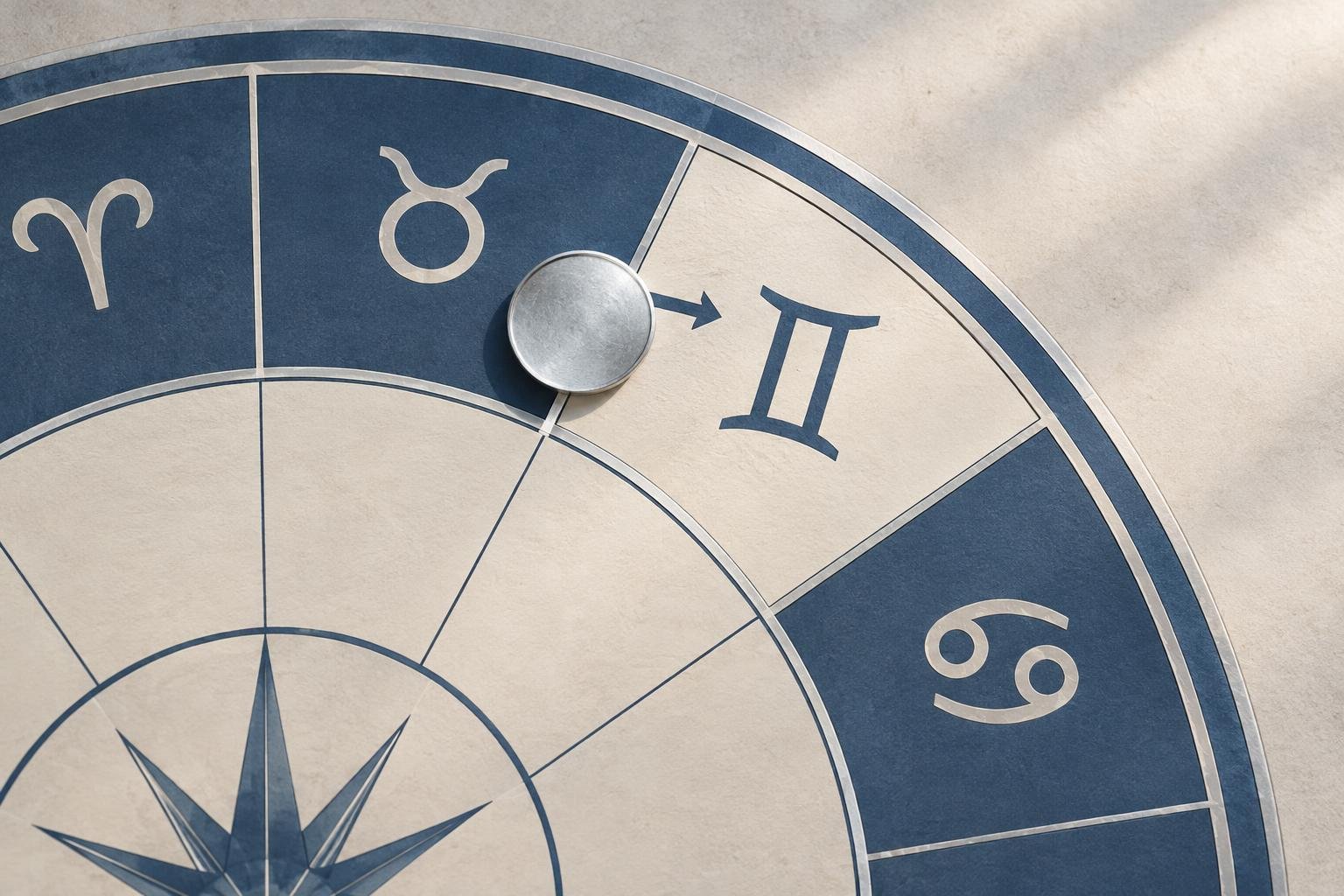
Think of a marker moving around a wheel divided into signs. The ingress is the instant the marker crosses a dividing line. Its subsequent journey through that section is its stay in the sign.
These are related but distinct things:
- The ingress time identifies the crossing itself.
- The interpretation of the placement explores the combination of the body and the sign it has entered.
A calendar therefore answers “when?” before a reading begins to consider “what themes?”. Keeping those questions separate helps you understand why an entry can have an exact timestamp while its interpretation uses broader language.
You can see how these entries appear alongside other events in the October astrology calendar.
One example: the Moon enters Gemini
On 28 October 2026 at 01:01, London time, the Moon will enter Gemini. That time marks the Moon’s passage across the sign boundary.
It does not name the hour when you must have a conversation, feel differently or make a decision. There is no need to stay awake waiting for a personal turning point. The timestamp locates the ingress; the reading concerns the lunar themes associated with the placement.
To interpret this entry, start by keeping both parts of its name in view. “Moon” tells you which set of themes to consider. “Gemini” describes a way those themes may find expression.
Reading only the word Gemini would leave out half the information. Reading only the time would tell you when the crossing happens, but nothing about how astrologers approach the placement.
The body supplies the theme, the sign its style
The Moon’s associations include emotions, instinctive responses, care, home and familiar habits. These are the subjects we bring to the example.
Gemini adds curiosity, quickness and a readiness to exchange ideas. It can also suggest attention moving between several things rather than remaining with one.
Put them together and the reading becomes more specific: lunar needs expressed through a curious, communicative style.
Feelings and the search for words
With the Moon in Gemini, one theme to explore is the wish to talk something through. A feeling may become easier to approach through a question, a conversation or a few lines in a notebook.
The useful emphasis is not simply “more talking”. Gemini’s curiosity invites distinctions: am I looking for reassurance, a different perspective or someone willing to listen? The lunar subject remains the emotional need; the Gemini style is the attempt to approach it through words and exchange.
Care expressed through interest
Care need not always take the form of doing something practical. Within this combination, it might be expressed by asking a thoughtful question, remembering what someone wanted to discuss or making room for an informal catch-up.
Here, the Moon supplies the concern for comfort and connection. Gemini supplies an attentive, conversational route towards it. That is a fuller reading than simply attaching “sociable” to the date.
Curiosity and divided attention
Gemini’s quickness also brings a useful contrast. Asking several questions may open up a feeling, but moving immediately to the next subject may leave little room for an answer.
A balanced interpretation can hold both possibilities: lively exchange and scattered attention. You might notice which one better describes a particular moment, rather than expecting every keyword to apply at once.
This is a reading of a lunar placement, not a character sketch of people born under Gemini.
An exact time does not mean a long-lasting theme
The precision of a timestamp says nothing about the duration or importance of the interpretation. A brief lunar change can be timed just as precisely as a transition involving a much slower planet.
The body sets the pace as well as supplying the subject. Lunar symbolism belongs to a short timescale: hours, or roughly a day’s changing emphasis. It is better approached as a passing tone than as the foundation of a long-term forecast.
Slow-moving planets, by contrast, provide a longer background. Their entries call for a different sense of scale. The word “ingress” describes the same kind of boundary crossing, but it does not make every crossing equivalent.
It also helps to distinguish time spent in a sign from the duration of a noticeable theme. A placement’s beginning is a calendar fact; describing how its themes unfold requires more than treating the entry time as an on-switch.
Three questions to ask of any ingress
Before reading an interpretation, pause over three basic questions:
- Which body is entering? Identify the themes being discussed.
- Which sign is it entering? Look for the style or approach added to those themes.
- What timescale suits that body? Keep a passing lunar emphasis in proportion to a longer planetary background.
For our example, the answers are the Moon, Gemini and a short-lived lunar emphasis. That gives you a clear starting point: feelings, habits and care considered through curiosity and exchange.
An ingress entry alone does not identify your ascendant, locate the placement in your natal houses or establish its personal significance. What it does offer is a useful piece of the calendar—and a straightforward way to practise combining a celestial body’s themes with a sign’s style.
Astrological overview of the period
| Date and time (London) | Event | Body | Sign |
|---|---|---|---|
| October 28, 2026, 01:01 | sign ingress | Moon | Gemini |
| October 30, 2026, 02:05 | sign ingress | Moon | Cancer |
| November 1, 2026, 04:18 | sign ingress | Moon | Leo |