
Same Sky, Different Chart: How Orb Conventions Change the Aspect List, and What a Continuous Model of Aspect Strength Does and Does Not Repair
Download PDFDOI 10.5281/zenodo.24635142Data, code and review records
Abstract
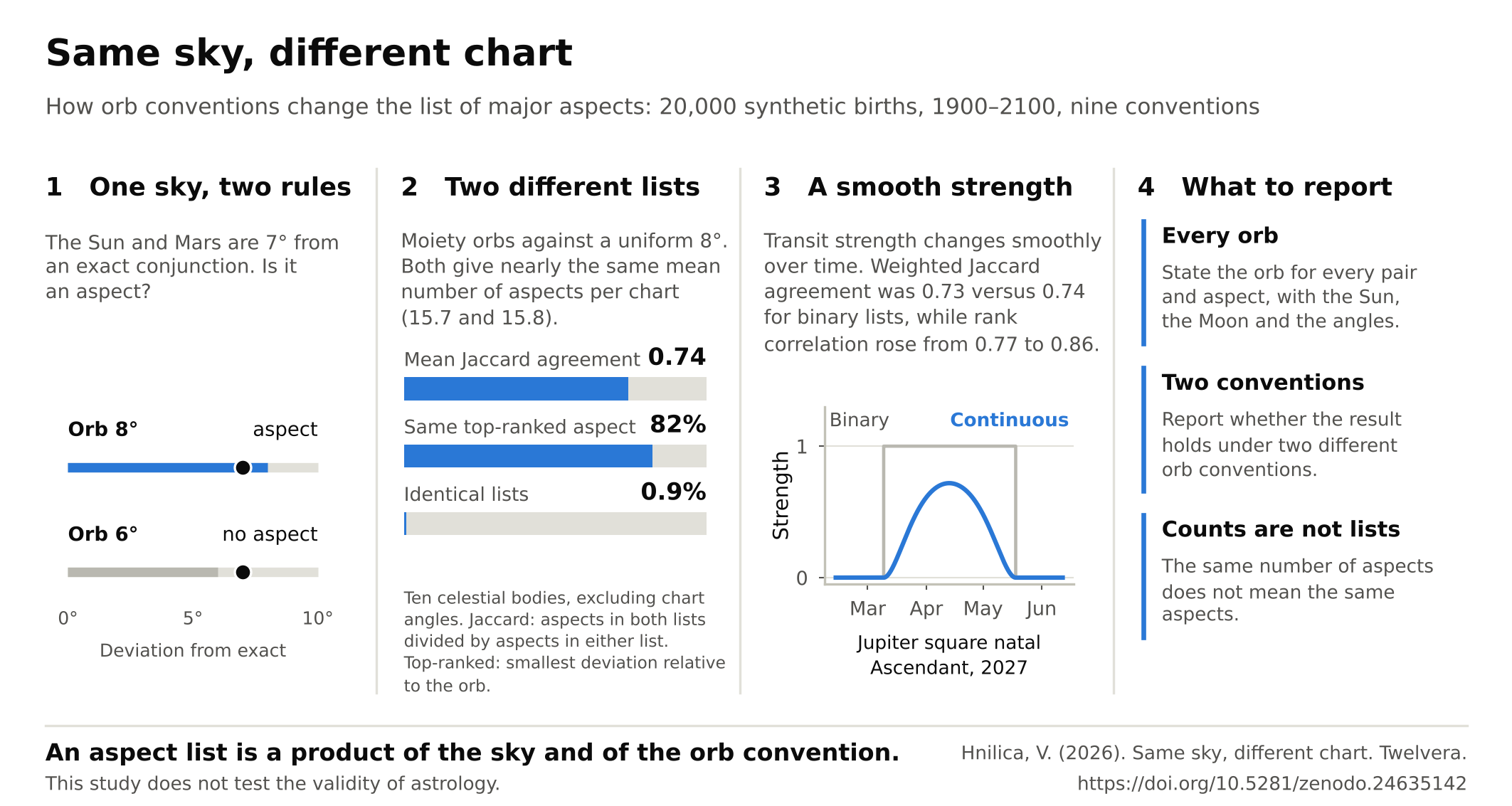
Astrologers and astrological researchers do not agree on how wide the orb of an aspect should be, and published studies use many conventions. We measured how much the list of major aspects in a chart depends on that choice. For 20,000 synthetic births between 1900 and 2100 we compared nine conventions: moiety orbs in the tradition of Lilly, extended to the outer planets and the chart angles, five uniform orbs, two orbs that depend on the aspect, and the recommendation of the Faculty of Astrological Studies as reported in the literature. Moiety orbs and a uniform orb of 8° gave almost the same mean number of aspects per chart (15.7 and 15.8), yet the two lists had a mean Jaccard agreement of 0.74 and were identical in 0.9% of charts. The tightest aspect of the chart was the same in 82% of charts. A continuous strength that falls smoothly to zero at the orb did not improve agreement between these two conventions (weighted Jaccard 0.73 against 0.74), although the rank order of the aspects agreed better (rank correlation 0.86 against 0.77) and the strength of a chart's transits became continuous in time, where the binary count changed in about 2,600 hourly intervals per chart in a year. A kernel of fixed width raised the agreement between the same two conventions to 0.93–1.00, largely by construction, and brought the jumps back wherever a narrower orb cut it off above zero. Two uniform orbs that differ by 1° gave the same list in about one chart in seven. We recommend that studies state the orb for every pair and report results under at least two conventions. The study concerns what software computes and does not test the validity of astrology.
How to cite
Hnilica, V. (2026). Same sky, different chart: How orb conventions change the aspect list, and what a continuous model of aspect strength does and does not repair [Preprint]. Zenodo. https://doi.org/10.5281/zenodo.24635142
Author
Vít Hnilica
Software developer and creator of Twelvera.
ORCID 0009-0000-9993-9648