
Factual Accuracy of Large Language Models in Natal Chart Interpretation: A Comparative Study of 22 Models
Download PDFDOI 10.5281/zenodo.24615466Data, code and review records
Abstract
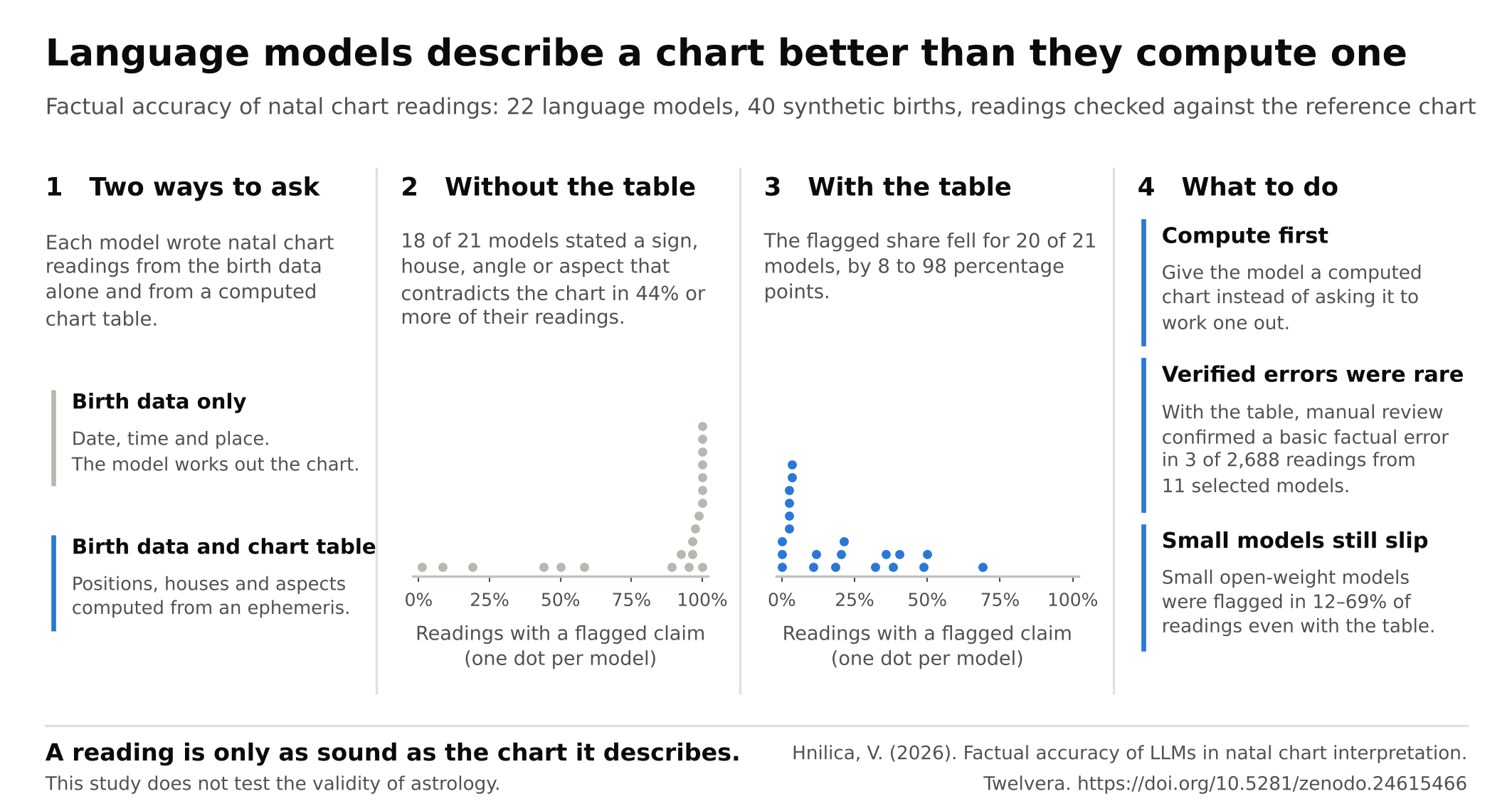
Large language models are widely used to write natal chart readings, yet a reading can only be as sound as the chart it describes. We measured how often 22 language models (8 proprietary, 14 open-weight) state chart facts that contradict a reference chart, and whether supplying a computed chart table changes this. For 40 synthetic births (28 with a known birth time) each model wrote three English readings under up to five conditions: birth data only (P0), a computed table of positions, houses and aspects (P1), the same table with row identifiers to cite (P2), and two richer structured inputs (P3, P4). A rule-based detector compared stated signs, houses, angles and aspect types with the reference chart; every detector flag in conditions P1–P4 for 11 selected models was then reviewed manually. Without a table, 18 of 21 models produced at least one flagged claim in 44 % or more of known-time readings, and 15 in 89 % or more; one model was flagged in 1 of 82 readings. With the table, the flagged share fell for 20 of 21 models, by 8 to 98 percentage points (birth-level permutation tests, Holm-adjusted p < 0.05 for 19 of the 20). Among 2,688 known-time readings from the 11 selected models, manual review of detector flags confirmed a basic factual error in three readings. A separate review of 30 unflagged readings found no additional basic errors. Most remaining flags were loose wording or detector false positives. Small open-weight models were still flagged in 12–69 % of readings with the table. Richer input did not consistently improve the accuracy of basic claims, and four derived errors found in a small sample came only from the richer conditions. The study concerns agreement between text and chart; it does not test the validity of astrology.
How to cite
Hnilica, V. (2026). Factual accuracy of large language models in natal chart interpretation: A comparative study of 22 models [Preprint]. Zenodo. https://doi.org/10.5281/zenodo.24615466
Author
Vít Hnilica
Software developer and creator of Twelvera.
ORCID 0009-0000-9993-9648