
What Should Chance Look Like? Base Rates of Planetary Aspects, 1900–2100, and False Positives in Aspect Studies
Download PDFDOI 10.5281/zenodo.24633982Data, code and review records
Abstract
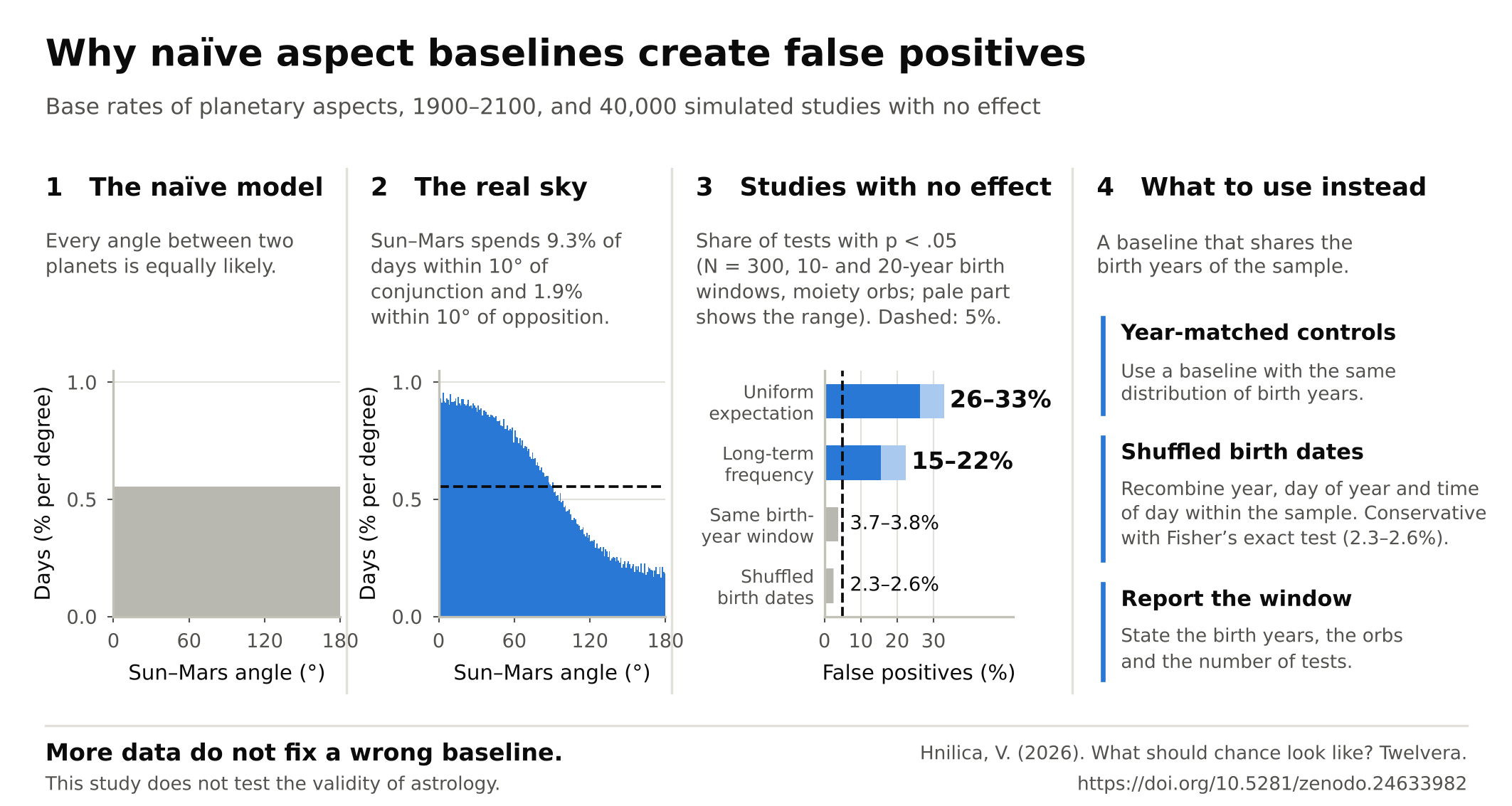
Statistical studies of astrological aspects compare how often an aspect occurs in a sample with how often it should occur by chance, and the result depends on that expectation. We computed how often each aspect between ten bodies actually occurred from 1900 to 2100, using the JPL DE442s ephemeris, and compared it with the common assumption that the angle between two bodies is uniformly distributed. With traditional moiety orbs, 57 of 225 pair-and-aspect combinations (25%) differed from the uniform expectation by more than 10%, and 13 never occurred. We then simulated 40,000 studies in which births were drawn at random from a window of years, so that no astrological effect was present, and tested all 225 combinations in each. With 300 births from a window of 10 to 20 years, 26–33% of tests were significant at the 5% level against the uniform expectation and 15–22% against the long-term empirical rate. Against the rate in the same window of years the share was 3.7–3.8%, and against a control made by shuffling the components of the sample's own birth dates it was 2.3–2.6%. Correction for multiple testing did not repair the first two baselines. We provide reference tables and recommendations for control groups. The study concerns the measurement of chance and does not test the validity of astrology.
How to cite
Hnilica, V. (2026). What should chance look like? Base rates of planetary aspects, 1900–2100, and false positives in aspect studies [Preprint]. Zenodo. https://doi.org/10.5281/zenodo.24633982
Author
Vít Hnilica
Software developer and creator of Twelvera.
ORCID 0009-0000-9993-9648