
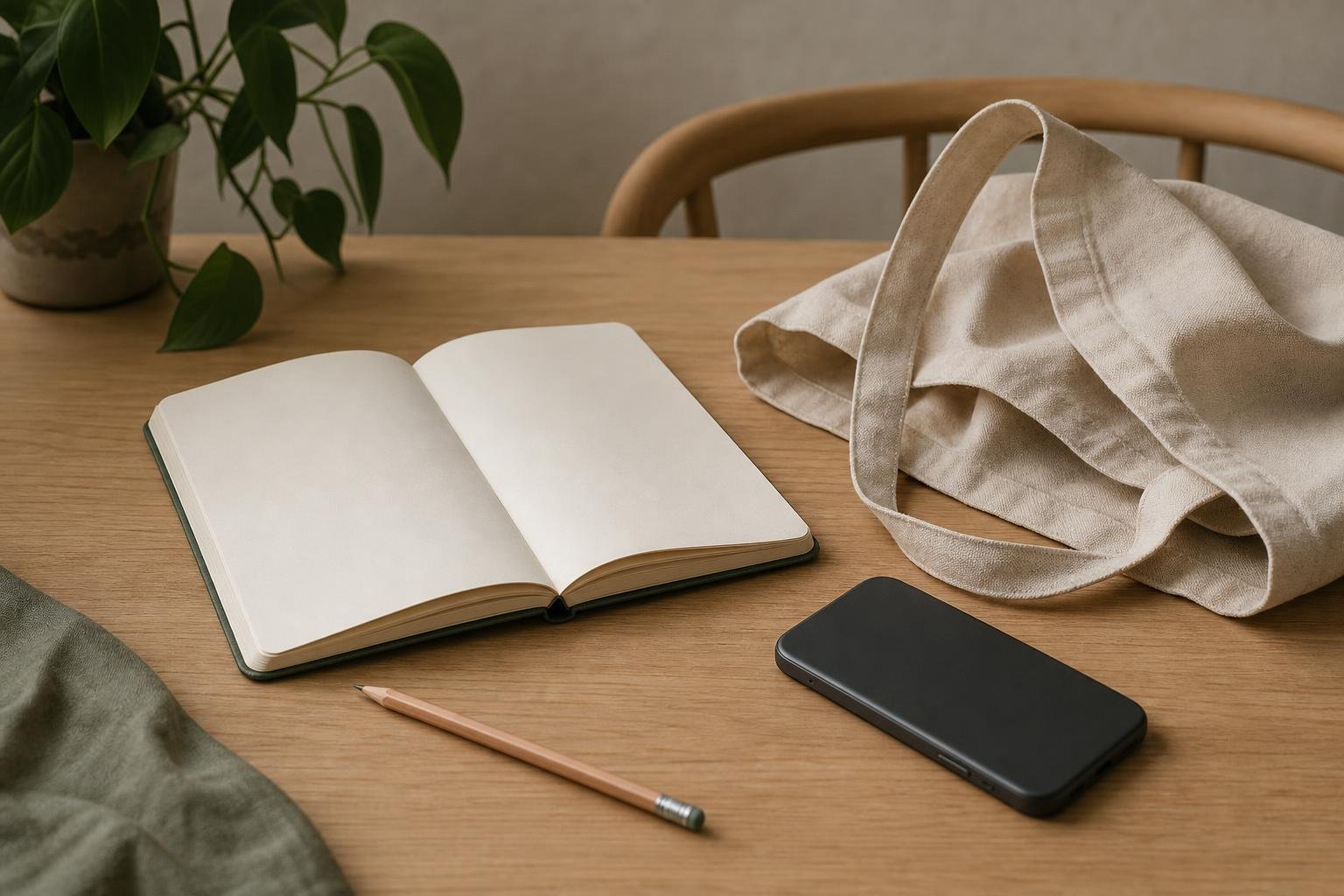
An unplanned purchase can begin with a small moment: something catches your eye while you are looking for something else. Perhaps you put it in your basket. Perhaps you close the page and forget about it. From 8 to 14 October, try paying attention to those moments—not to judge what you buy, but to see what happens between wanting an item and making a decision.
You need only a notebook or a note on your phone. When you notice the urge to buy something you had not intended to get, jot down a few details. If you can, leave the decision for later and come back to what you wrote. The experiment is not a ban on spontaneous purchases, and there is no target number of entries. One useful observation is enough to make the exercise worthwhile.
What to write down in the moment
Keep the note short enough that you will actually make it. Start with three things: the item, the situation and the appeal. You might write, “Striped mug; browsing on my phone after dinner; liked the colour and imagined using it at my desk.” Another entry could be, “Extra notebook; passed the shop on my way home; wanted a fresh start for a project.”
The point is to describe what you noticed, not to explain your entire personality. Where were you? What were you doing just before the item appeared? Was it something you went looking for, or did it find its way into your view? What, specifically, attracted you: its appearance, a possible use, the convenience of having it now, or the idea of giving it to someone?
If you like, add what you decided at the time: bought it, left it, saved it for later or had not decided. A note that says “I wanted it and bought it” is just as welcome as one that ends “I walked away.” Both tell you something about the moment. Try to avoid labels such as “good” or “bad” purchase while you are recording it; you can consider the decision when you return to the note.
Put a little space before the decision
For this week’s experiment, the pause matters because it gives you a second view of the same item. When it is practical, set the decision aside and choose a time to look at your note again—later that day or the next day, for example. You do not need to keep thinking about the item in the meantime.
A pause is not a rule that suits every purchase. Sometimes you are replacing something you need, working to a deadline or buying on someone else’s behalf. If waiting does not make sense, record that too. The experiment works better when it reflects your ordinary circumstances rather than forcing every situation into the same routine.
When you return, read the original note before opening the shop page or going back to the shelf. Does the appeal still make sense to you? Is the item still on your mind, or had it slipped away until you saw the note? You can add one sentence about your decision then. There is no need to talk yourself into or out of buying it; you are comparing two moments, not sitting a test.
Look back at the week, not just each item
After 14 October, read the entries together. You may have several, or only one. Either way, begin with what is actually on the page rather than trying to find a pattern at all costs.
A few questions can guide the review:
- Did an urge tend to appear in a particular setting, such as while browsing at home or walking through a shop?
- Were you drawn to similar qualities in different items?
- Did the reason you gave in the moment still fit when you read it later?
- Did pausing change how you saw any item, whether or not you bought it?
Similar entries do not prove that you will behave the same way next time. And if every note is different, that is an observation too. The most useful outcome may be modest: a clearer memory of what caught your attention, in place of a vague impression that you “always” or “never” shop a certain way.
Where the horoscope fits
The week also includes a new moon in Libra on 10 October. In an astrological reading, Libra can prompt questions about weighing options. Here, that is simply a reminder to stop and make a note; it does not explain why a particular item appealed to you or say what you should buy. Your entries are the record of what happened, and you can review them without referring to the horoscope at all.
If the reminder helps, use it when you encounter a possible purchase: “What caught my eye, and do I want to decide now?” If it does not, the notebook exercise stands on its own. At the end of the seven days, you will have something more specific than a forecast—a handful of your own observations, written close to the moments they describe.
Astrological overview of the period
| Date and time (London) | Event | Body | Sign |
|---|---|---|---|
| October 9, 2026, 09:10 | sign ingress | Moon | Libra |
| October 10, 2026, 16:50 | new moon | Moon | Libra |
| October 11, 2026, 16:21 | sign ingress | Moon | Scorpio |
| October 14, 2026, 01:59 | sign ingress | Moon | Sagittarius |